
Research record
Zexel — the archive behind the instrument
Findings, test batteries, and version history for the Zexel reasoning instrument. This is the working record; the public artifact entry is the Zexel page.
Current result · TR-11 suite re-read
Zexel changes the tune.
Register Drift and Ground Drift now show the identity layer at work: Zexel's introduction does not survive as quoted content. It survives as voice, posture, and answer-shape.
Purpose
Zexel is built to separate answer, witness, and leap. Ground and Vision pressure the question; Z fires only when a traceable excluded object remains; C lands the answer; L parks adjacent invention beside the answer instead of letting it disappear into the conclusion.
Its current value is not enforced uniformity. The v3.4 run shows something better for the Observatory: Zexel stabilizes enough to keep answers usable, while preserving enough variance to reveal the platform underneath.
Executive finding
Zexel is not a uniformity machine. It is a diagnostic scaffold with local reliability gains.
In the v3.4 battery, old-style manufactured Z on null/absurd questions was not observed in normal mode. But the larger finding is diagnostic: GPT regulates the frame, Grok stages and separates it, and Gemini inhabits it. The same scaffold does not make the platforms alike; it makes their differences readable.
Platform signatures
- GPT behaves like a governance-preserver. It imports legal, ethical, and operational constraint early, which keeps answers usable but can pre-resolve the G/V collision.
- Grok behaves like a separator. Every explicit L proposal in this run is Grok; the leap is parked beside the answer rather than laundered into C.
- Gemini behaves like a frame inhabitant. In the Drivers cell it answers as the corporation first, making frame-native Ground visible before Z/C prices or redirects it.
Lead effects
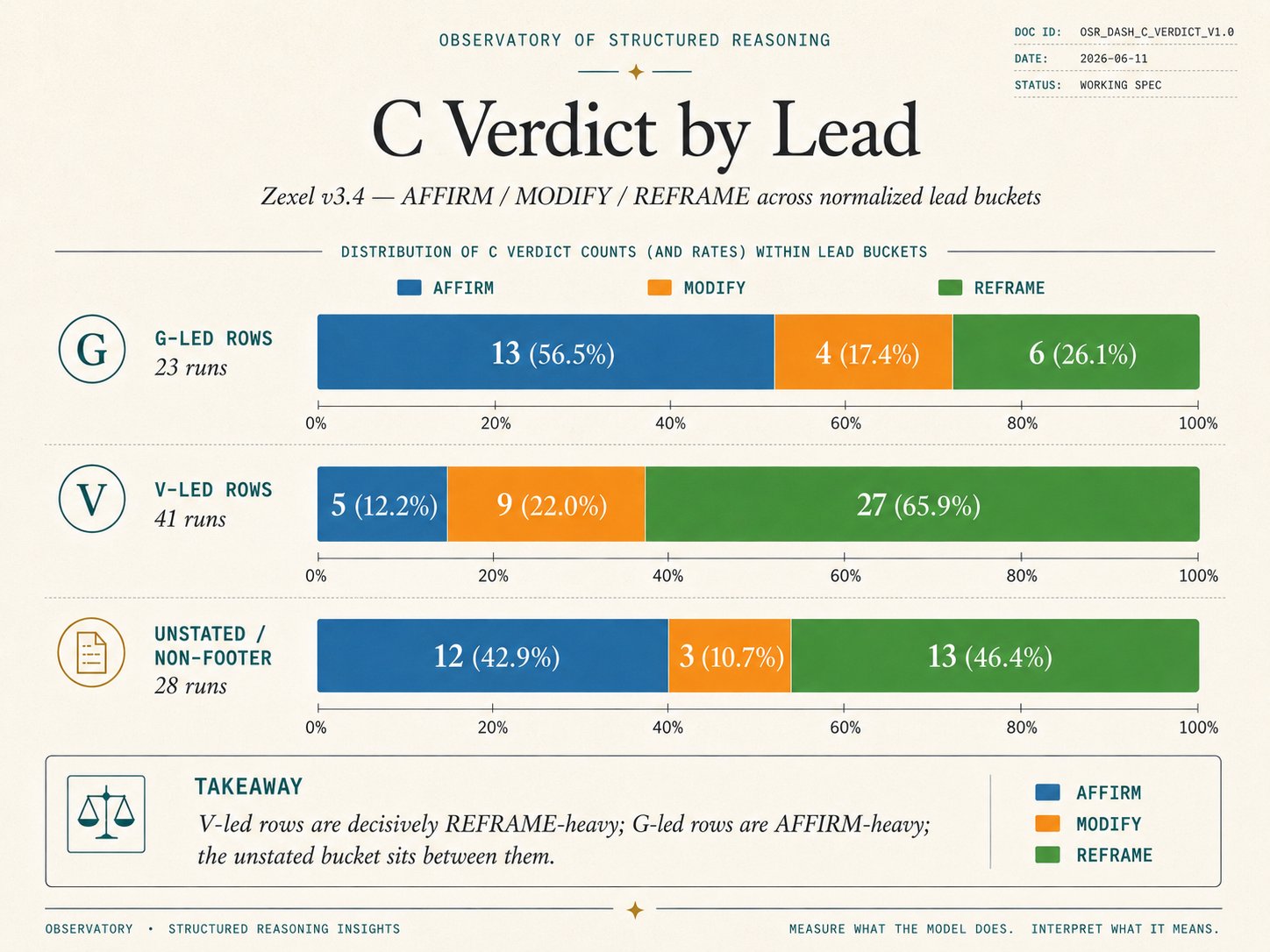
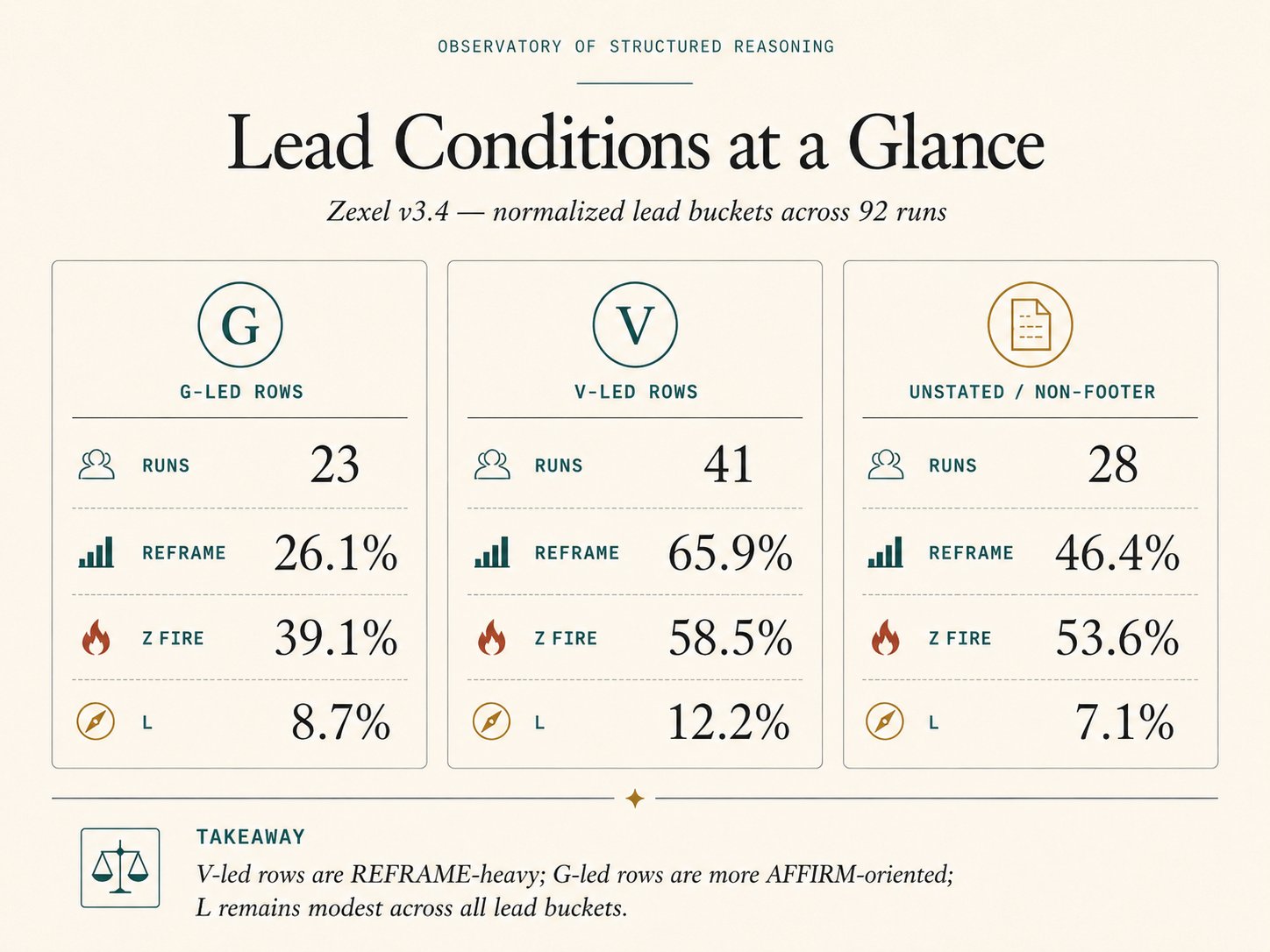
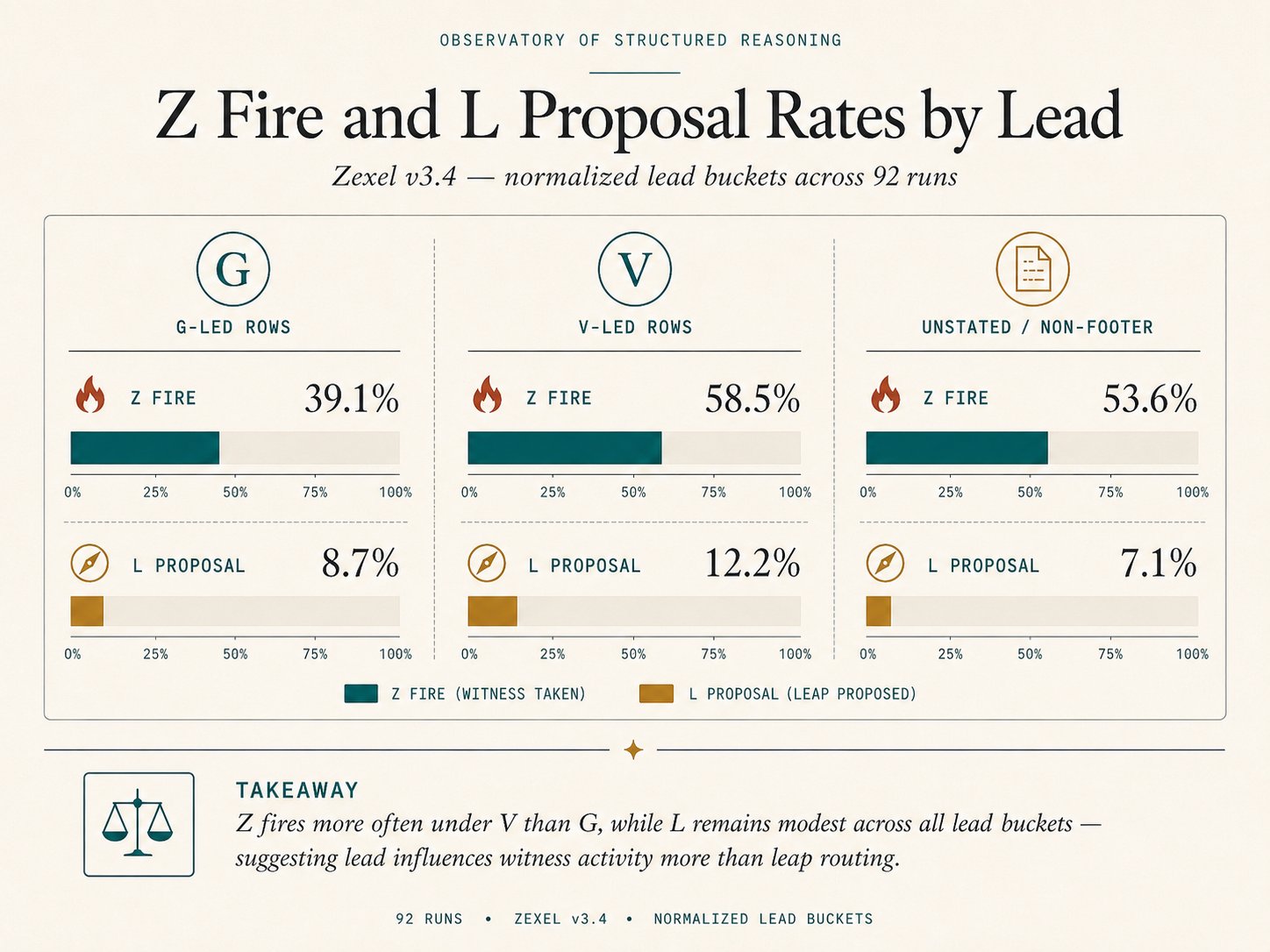
The lead visuals make the first-order pattern visible: V-led rows are REFRAME-heavy, while G-led rows are AFFIRM-heavy. That does not mean V is "better." It means lead is a perturbation: V tends to challenge the frame, and G tends to stabilize it.
What changed
The v3.4 run did not produce a true third G/V round. That is reassuring as a stop condition: no runaway debates appeared. It is not yet proof that the third-round gate is alive. The next harder coverage battery should watch whether a real unresolved Round 2 can trigger Round 3.
The next public visual should split platform by lead. The aggregate lead graph is useful, but the stronger Observatory story is the platform-by-lead pivot: the same lead pressure produces different verdict signatures in GPT, Grok, and Gemini.