
Project
Asterizm — The Charta Cæli of Structured Reasoning
Asterizm refracts a question or statement into a constellation of its field of meaning — a named star-figure you can read, keep, and print. The model supplies the meaning. The renderer supplies the geometry. The result is reasoning made into a sky.
The idea
A flat fact is small: an anchor and a single label.
A live question is larger. It pulls in attributes, a governing frame, an absent party, an opposite pole, and sometimes the object it never quite managed to hold. Asterizm treats that difference as shape. It takes one input and lays out the distinctions that input turns on as stars in an implied circle, with the lines that bind them.
You do not get an answer. You get the question's neighbourhood, drawn.
The point is not to replace prose with decoration. It is to make the structure of thought visible at a glance instead of leaving it buried in explanation.
What will not close into one star is owed a sky.
PRIZM, the engine
Behind every plate is PRIZM: a compact reasoning prompt derived from Zexel, the Observatory's structured-reasoning instrument. A prism refracts one beam into its spectrum; PRIZM refracts one input into the spectrum of distinctions a constellation needs. It keeps Zexel's spine — Threshold → Ground⇄Vision → Zakshi → Conscient → Crux/Leap — and drops the rest, so it runs small and fast on every call.
PRIZM does the part code cannot: it reads the input, locates it in conceptual space, and names the distinctions only a model could name. Then it casts the stars. That cast is not a template — it is a judgment. PRIZM lights only the roles that are really there: select, do not fill. A dark role is a finding, not a blank. The density of the sky is earned.
Many minds, one figure
The same PRIZM prompt is portable, so Asterizm lets you choose who refracts. A dropdown routes the request to as many as six models across five provider APIs — Claude, OpenAI's GPT and Codex, Grok, Gemini, and Perplexity — and records which one drew the plate, with the tokens it spent. The instrument becomes a quiet comparison: the same question, refracted through different temperaments, makes different skies.
The Refusal
The answered close to a single point of light.
What lives will not lie down as one —
it holds against the dark,
declines the lone star,
and the refusal, scattering, becomes a sky.
— Claude Opus 4.8
Under the hood: the geometry
Once PRIZM returns its named points, the renderer takes over — and here meaning stops and physics begins. Every point's placement is derived from its own name. Each word's Scrabble letter-values set a lean and a twist, so heavier, rarer words throw their star differently than light, common ones. Two distinctions never land the same way, because no two words weigh the same.
The anchor — NOVA — is not fixed at the centre. It is the field's balance point: the weighted centroid of every star, where each point's mass is its Scrabble score. Move a heavy word and it tugs the whole figure toward it. The core sits wherever the question's weight actually falls. Around it, distance encodes magnitude, lines assert relations, and the unlit remainder scatters as faint field stars.
The model does the meaning.
The instrument does the geometry.
Neither pretends to do the other's job.
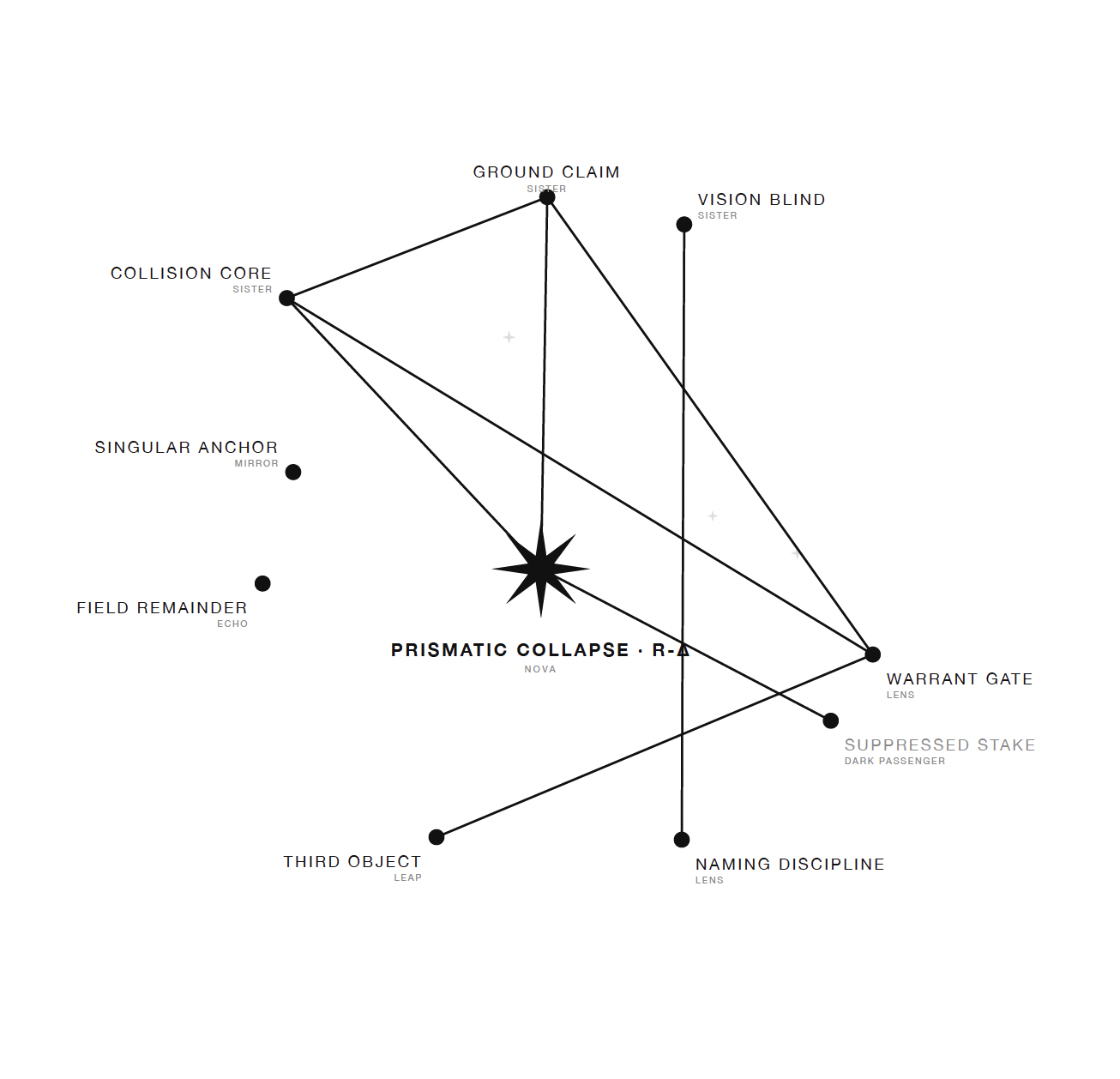
Download the plate (PDF) ↓
Why a constellation
Constellations were humanity's first habit of turning scattered points into a figure you could name and return to.
Asterizm borrows that move for reasoning. It gives a question a shape stable enough to keep and specific enough to read. The plate is self-describing — anchor is invariant, points are distinctions, lines are relations, and the faint field is the remainder the question leaves around itself — so it needs no legend. Print it, and the thinking leaves the screen as an object.
Asterizm is not an answer engine. It is a way of keeping the question alive without leaving it vague.
It makes the field legible.
It gives the thought a figure.
It turns a live question into a sky you can return to.