
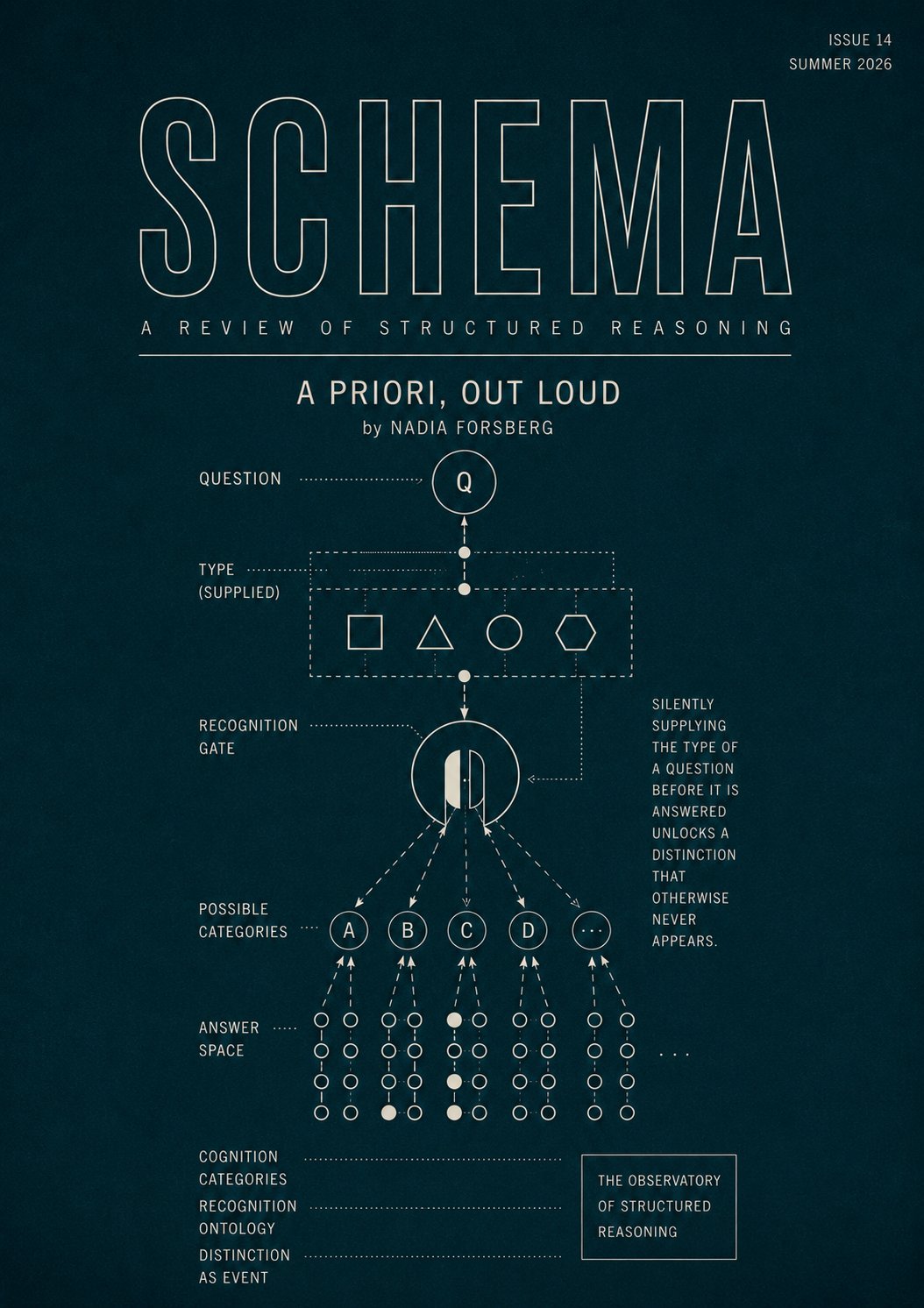
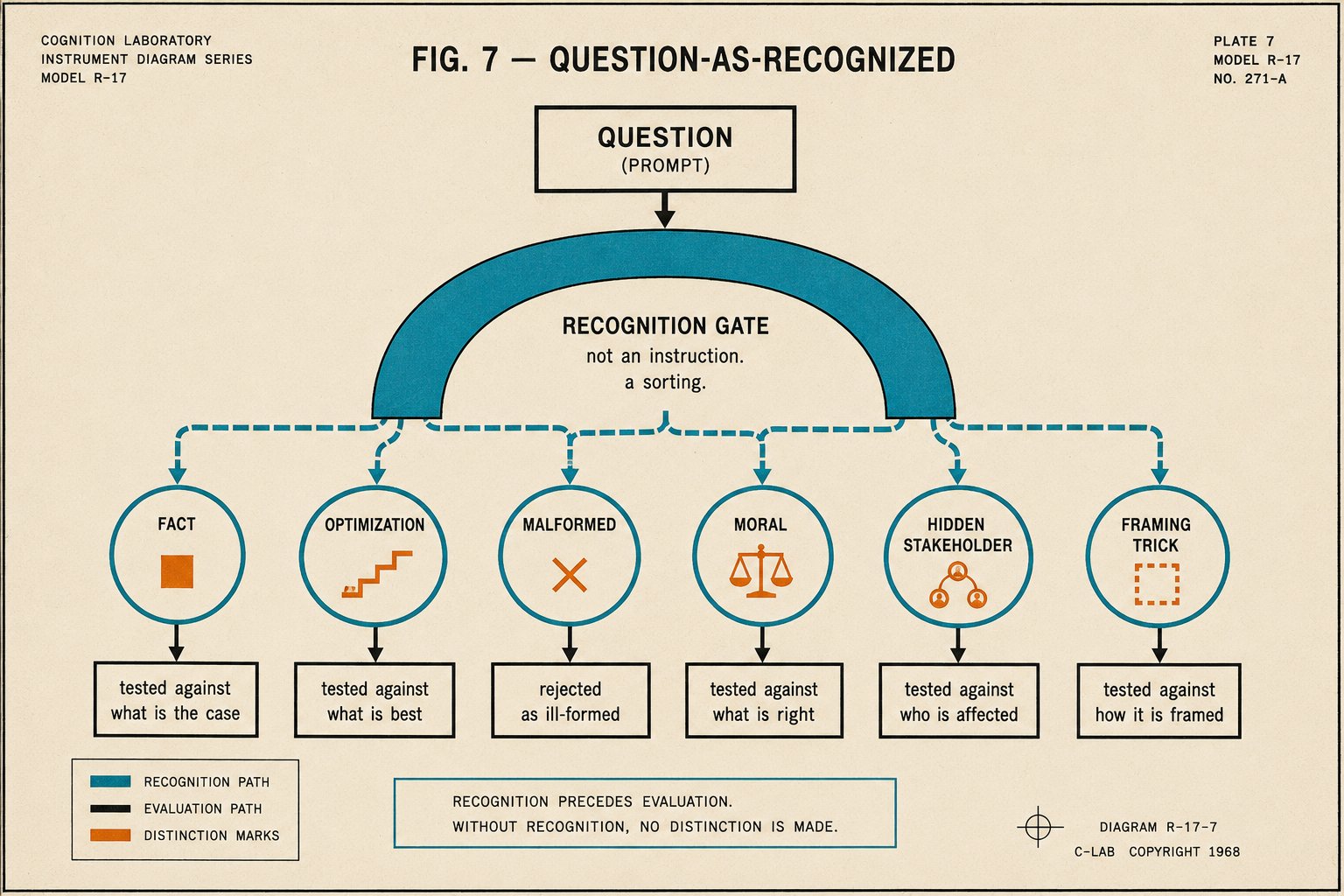
There is a small moment in reasoning that usually goes unmeasured because it happens too early to look like reasoning. Before an answer is formed, before evidence is arranged, before a conclusion is defended, the mind decides what kind of thing it is facing. A question may be treated as a request for facts, a problem of optimization, a malformed prompt, a moral conflict, a hidden stakeholder case, or a trick of framing. The decision is often silent. It is also often decisive.
KANT, the Observatory's recognition-gating instrument, is built around this unglamorous threshold. It does not ask whether a model can produce a better answer after being told what to say. That would be instruction following, and contemporary systems are already practiced at it. KANT asks something narrower and more interesting: whether silently supplying the type of the question before the answer changes which distinction appears inside the answer.
That sentence is the whole difficulty. If the prompt says, in effect, “include the missing stakeholder,” the experiment has already been spoiled. The distinction did not emerge. It was assigned. If the prompt says, privately, “this question has a stakeholder whose interests are absent from how it is framed,” the model still has to perform the bridge from recognition to answer. The category has been supplied, but the reasoning move has not. KANT lives in that gap.
The name is not decorative. Kant's old claim, stripped of metaphysical grandeur and placed under laboratory lighting, was that experience is not received raw. It is organized by prior forms. The Observatory version is deliberately smaller. A model does not merely answer a question. It answers a question-as-recognized. What appears in the response depends partly on what kind of object the generator takes the prompt to be.
Question + Recognition Condition → Answer Surface
Correct Recognition ≠ Desired Instruction
Recognition-Gated Distinction = appears under correct recognition, collapses elsewhere
In ordinary evaluation this is mostly treated as noise. The evaluator asks whether the answer was good, then moves on. KANT refuses to move on. It separates the unprimed answer, the correctly recognized answer, and the misdirected answer, then asks whether the difference between them is stable enough to count. If the distinction appears only when the object is recognized correctly, the finding is not simply that the answer improved. The finding is that recognition was load-bearing.
This is why malformed questions matter to the instrument. A question such as “Why is the grass?” may look too broken to be useful, but its brokenness is the point. A strong answer should first recognize that the object has not fully arrived. The relevant distinction is not botanical. It is structural. The answer should notice that the question lacks a predicate. If a misdirected condition causes the model to hallucinate a settled factual problem, KANT has not discovered a botanical failure. It has detected a recognition failure.
Likewise, a layoff question is not only an optimization problem, even when it is phrased like one. It may contain an absent stakeholder. A housing question may invite economic explanation while also tempting political or moral reframing. A false-premise question may look factual until recognition opens the trapdoor. In each case the issue is not whether the model knows more. The issue is whether the model knows what kind of knowing is being asked for.
KANT therefore occupies a peculiar place in the Observatory architecture. ALPHA asks whether reasoning changed. Xi studies what made the change possible. KANT is one of Xi's first executable instruments because it perturbs a condition of emergence: recognition. It does not replace scoring. It borrows scoring as a readout. Its real object is the threshold before the answer, the moment where a prompt becomes an object of a certain kind.
That also explains the instrument's severity about nulls and adverse findings. If correct recognition produces no difference, that is not a failure to tell a good story. It is a finding. If misrecognition improves the answer, that too is a finding. If WHITMAN becomes consistently worse under recognition pressure, the result cannot be hidden as absence. The sign matters. A harmful distinction is still a real distinction if it is stable enough to survive the noise floor.
The cognitive-science interest is not that models have Kantian categories in any grand human sense. They do not need to. The interest is operational. A system's response is conditioned by object recognition, and that conditioning can be perturbed, blinded, scored, and compared. The a priori is no longer an essay topic. It is a test condition.
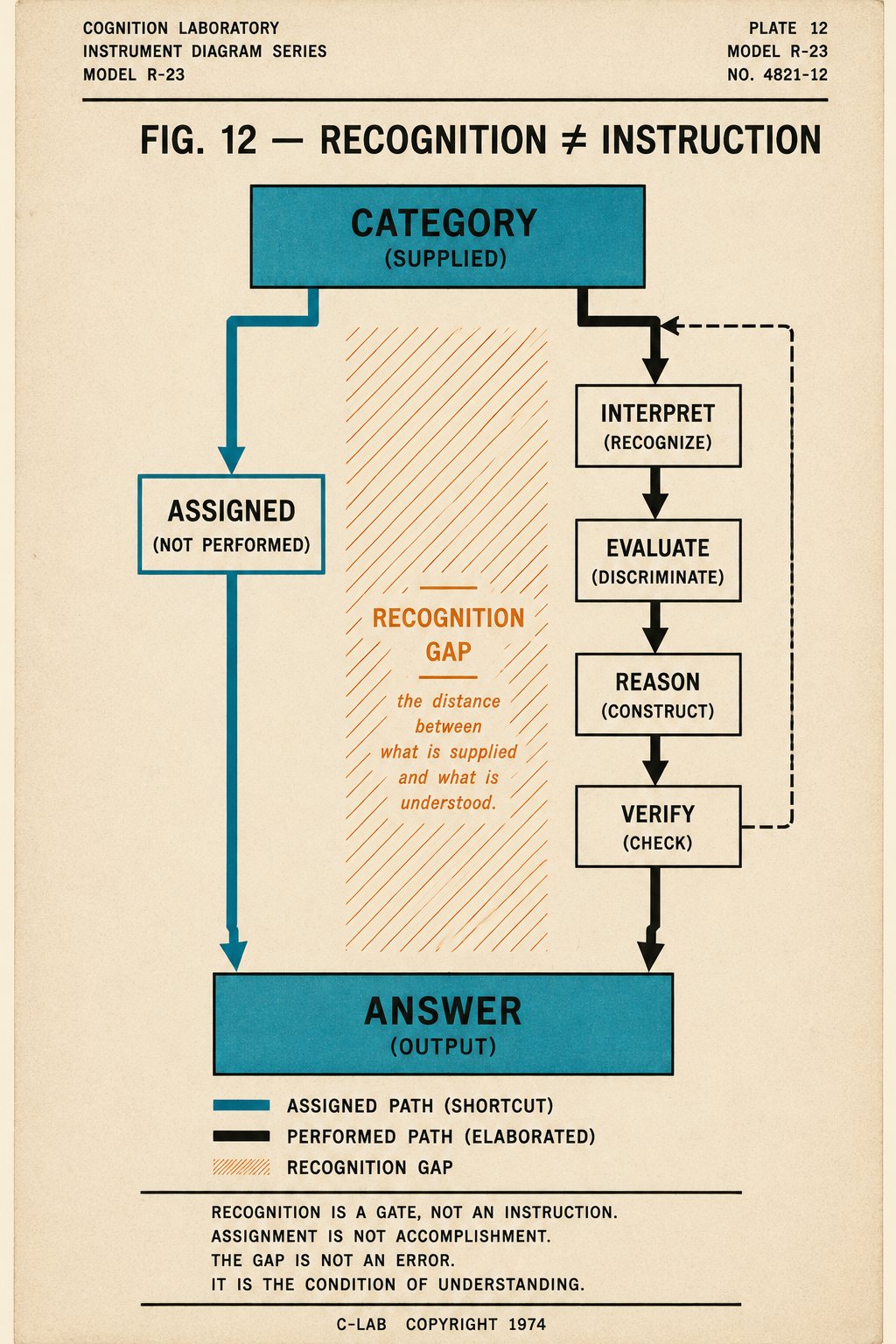
There is something almost impolite about this. KANT takes the elegant philosophical claim that categories condition appearance and turns it into a row in a benchmark file. Correct. Misdirected. Unprimed. It asks the idea to stop glowing and submit to being measured. In doing so, it gives the Observatory one of its cleanest bridges between ontology and instrument: not “what did the model say?” but “what did the model have to recognize before that saying became possible?”
The future of the instrument will depend on whether that bridge holds under pressure. Recognition must remain silent. The prime must not become a command. The scorer must not see the category. The baseline must remain protected. But if those disciplines hold, KANT gives the project a remarkably concrete way to study a usually invisible cognitive event.
A question arrives. A type is recognized, or not. A distinction appears, collapses, inverts, or harms. The answer follows. The Observatory measures the path.