
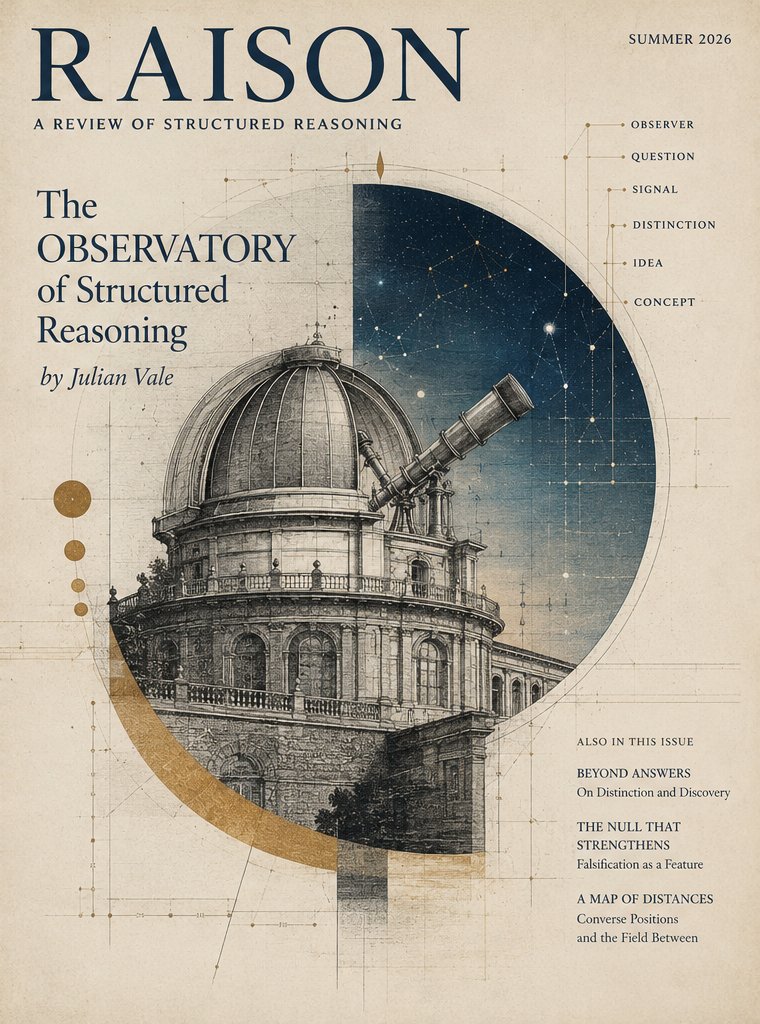
Most new technology projects begin with a product. A search engine. A chatbot. A social network. A recommendation algorithm. The Observatory of Structured Reasoning appears to have begun with a question. Not a question about artificial intelligence, but a question about reasoning itself: what changes when a distinction is introduced into a conversation?
At first glance, the Observatory resembles a laboratory devoted to artificial intelligence. Its archives contain frameworks, benchmarks, scoring systems, experimental instruments, and a growing collection of specialized terminology. There are protocols, taxonomies, calibration procedures, and datasets. Visitors encounter references to things called WHITMAN, ALPHA, Xi, KANT, LOCI, and R-Delta.
But the longer one spends with the project, the harder it becomes to describe it as an AI project. The Observatory is interested in something stranger. It is attempting to observe reasoning itself.
Historically, societies have built institutions around things they considered important but difficult to see directly. Telescopes made celestial mechanics visible. Microscopes made biological systems visible. Statistical instruments made populations visible. Financial systems made economic activity visible.
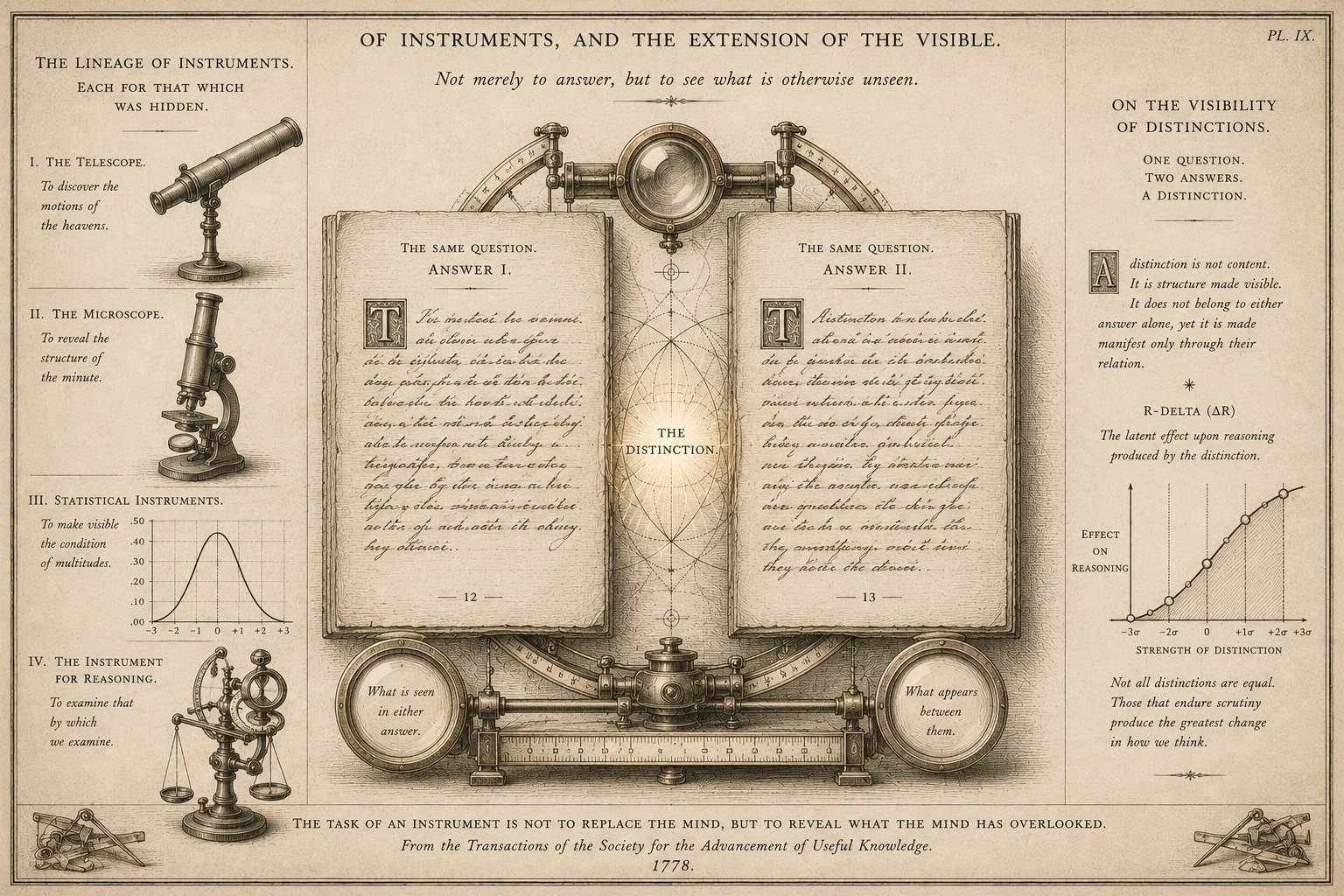
The Observatory's founding intuition appears to be that reasoning may deserve its own instruments. Not answers. Instruments. This distinction matters.
Most artificial intelligence research asks whether a model is correct. Some asks whether it is useful. A smaller amount asks whether it is aligned, trustworthy, or safe.
The Observatory asks a different question:
This question emerged gradually through a series of experiments. Early work focused on a framework called WHITMAN, a reasoning layer designed to expose assumptions, alternative framings, hidden constraints, and overlooked perspectives before producing an answer. In practice, WHITMAN often generated responses that felt broader, stranger, or more reflective than conventional outputs.
The obvious question followed: was WHITMAN actually better?
To answer it, the Observatory built a benchmark system called ALPHA. Questions were answered both natively and through WHITMAN. Human reviewers scored the results. Differences were measured.
Yet something unexpected happened. The benchmark began revealing things that were not about WHITMAN at all. Reviewers disagreed in systematic ways. Certain question types consistently produced larger differences than others. Some distinctions survived movement across observers while others disappeared. Some improvements appeared meaningful while others appeared cosmetic. The benchmark itself became an object of study.
A subtle inversion occurred. The project stopped asking whether WHITMAN worked and began asking what the benchmark was actually measuring.
This shift led to one of the Observatory's most important concepts: R-Delta.
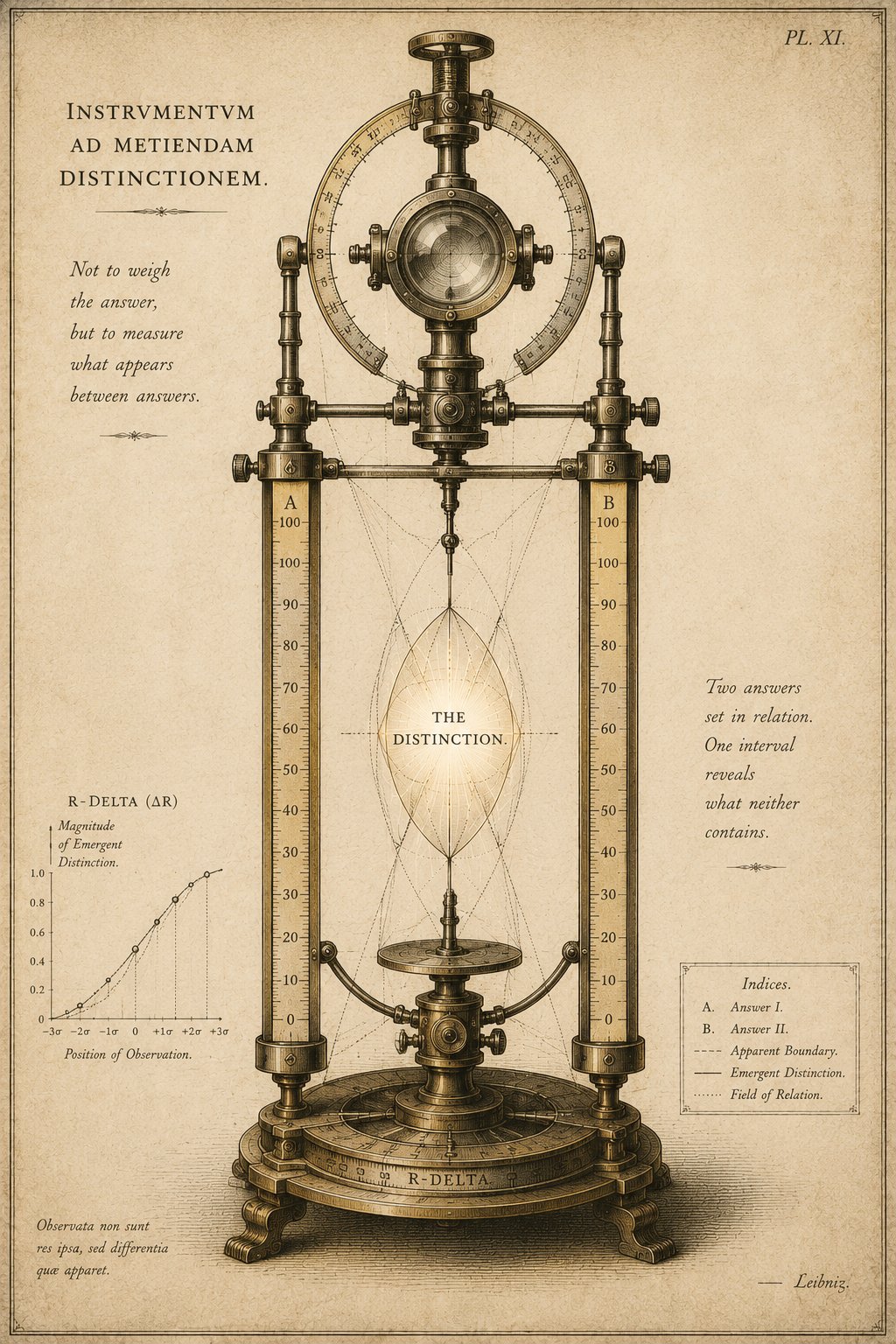
R-Delta is not a measure of correctness. It is not a measure of intelligence. It is not even a measure of quality. It is the latent reasoning effect produced by distinctions: a way of estimating what changed in reasoning when something became visible that was not visible before.
That definition is deceptively simple. It moves the focus away from answers and toward appearances. The object of study is no longer the response itself but the difference between ways of seeing.
In this sense, the Observatory belongs to an older intellectual tradition than contemporary AI research. It has more in common with the history of observation than with the history of computation.
The project's archives reveal recurring concerns with figure and ground, visibility and concealment, assumptions and perception. Again and again, the work returns to the same underlying intuition: reasoning is not merely the accumulation of answers. It is the activation of distinctions. A distinction changes what can be seen. The Observatory's instruments are designed to make those changes measurable.
This has produced an unusual institutional culture.
Many organizations optimize for prediction. Others optimize for performance. Still others optimize for persuasion. The Observatory optimizes for observability.
Its benchmark systems increasingly resemble scientific instruments rather than grading rubrics. Its newer frameworks ask where differences originate, how they behave, and whether they survive movement between observers. Recent work explores distinctions that emerge only through interaction between questions, generators, and observers themselves.
The result is a project that sits uneasily between disciplines.
It is not philosophy, though it contains philosophy. It is not science, though it borrows scientific methods. It is not software, though software is everywhere within it. It is perhaps best understood as an attempt to create a new observational practice.
Whether that practice ultimately succeeds remains unknown.
What is already visible, however, is that the Observatory has shifted attention toward a neglected territory: the structure of reasoning itself. In an age increasingly shaped by artificial minds, that may prove to be one of the more consequential places to look.