
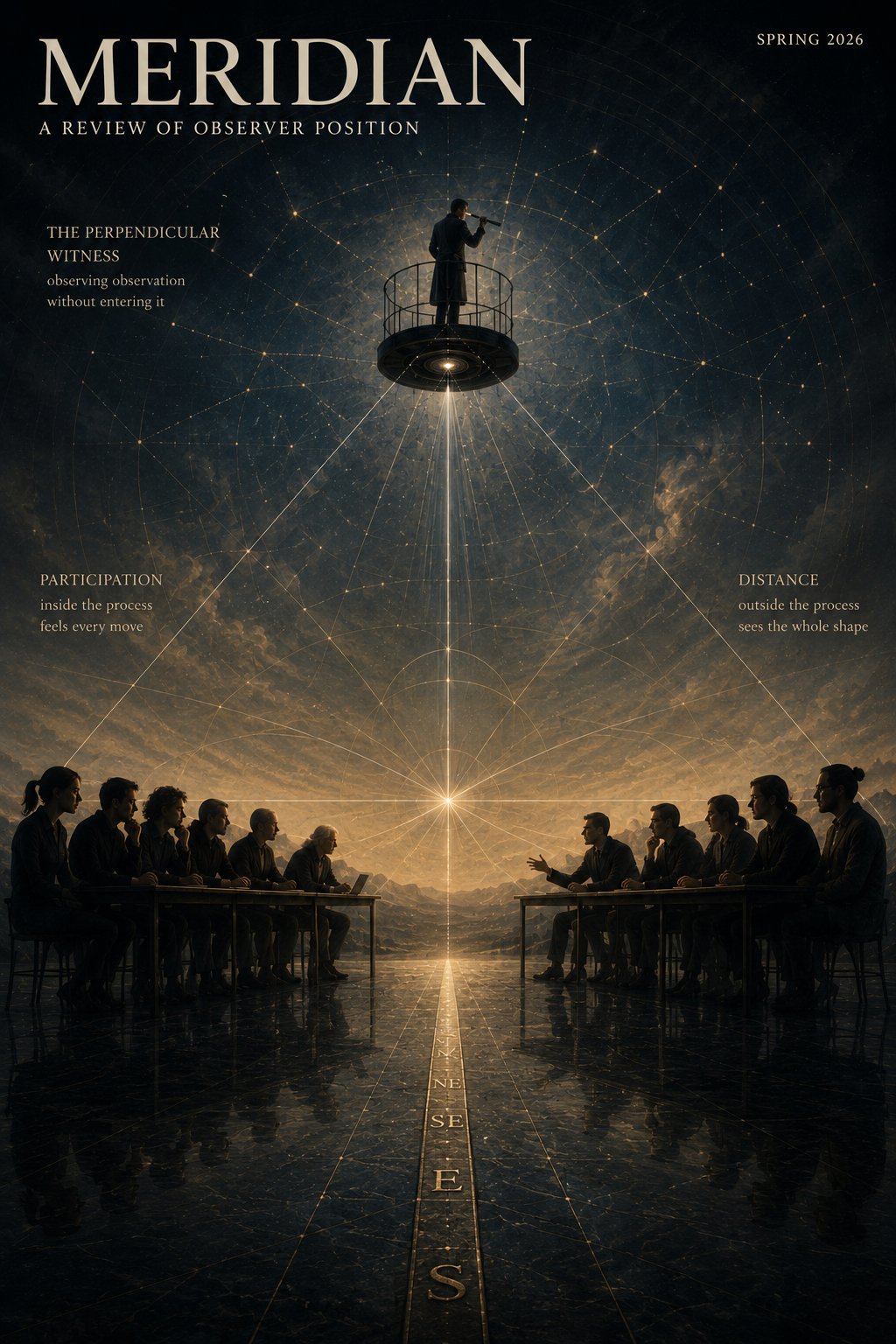
Every measurement assumes a place to stand. The thermometer assumes contact. The survey assumes a baseline between two known points. Classical science spent three centuries trying to make that place disappear — to describe the world as it would look from nowhere in particular, by no one in particular. The Observatory of Structured Reasoning has arrived, by a less comfortable route, at the opposite conviction.
It is one of the project's locked precepts, and it is easy to read it as a humility note — a reminder that observers are biased and should be corrected for. That is not what it says. It says the position is not noise around the phenomenon. It is inside it. Remove the observer and you have not cleaned the measurement; you have deleted part of what was being measured.
The realization did not arrive as theory. It arrived as an inconvenience.
The Observatory scores the difference between a structured reasoning pass and an unstructured one. Early on it assumed that difference lived in the answers — that a fixed pair of responses carried a fixed amount of effect, waiting to be read off. Then the same pair began returning different readings depending on who was reading, and how much that reader already knew about the instrument that produced it.
The project named the variable conversance: the degree to which an observer is already fluent in what they are looking at. A conversant reader recognizes the moves and credits them. A reader who has never seen the apparatus judges only what is on the page. Neither is wrong. But they do not return the same number.
R̂-Delta = scorer's estimate of R-Delta
R̂-Delta = f( R-Delta , observer position )
same artifact / different position → different valid aspects
This is why the Observatory treats the non-conversant baseline as precious rather than primitive. The reader who knows nothing is not a deficient instrument to be upgraded. They are a clean zero — a position from which the apparatus cannot flatter itself. The cleanest reading the project has found of its own effect came not from its most expert observer but from its least invested one.
There is an older language for this, and the Observatory uses it without apology.
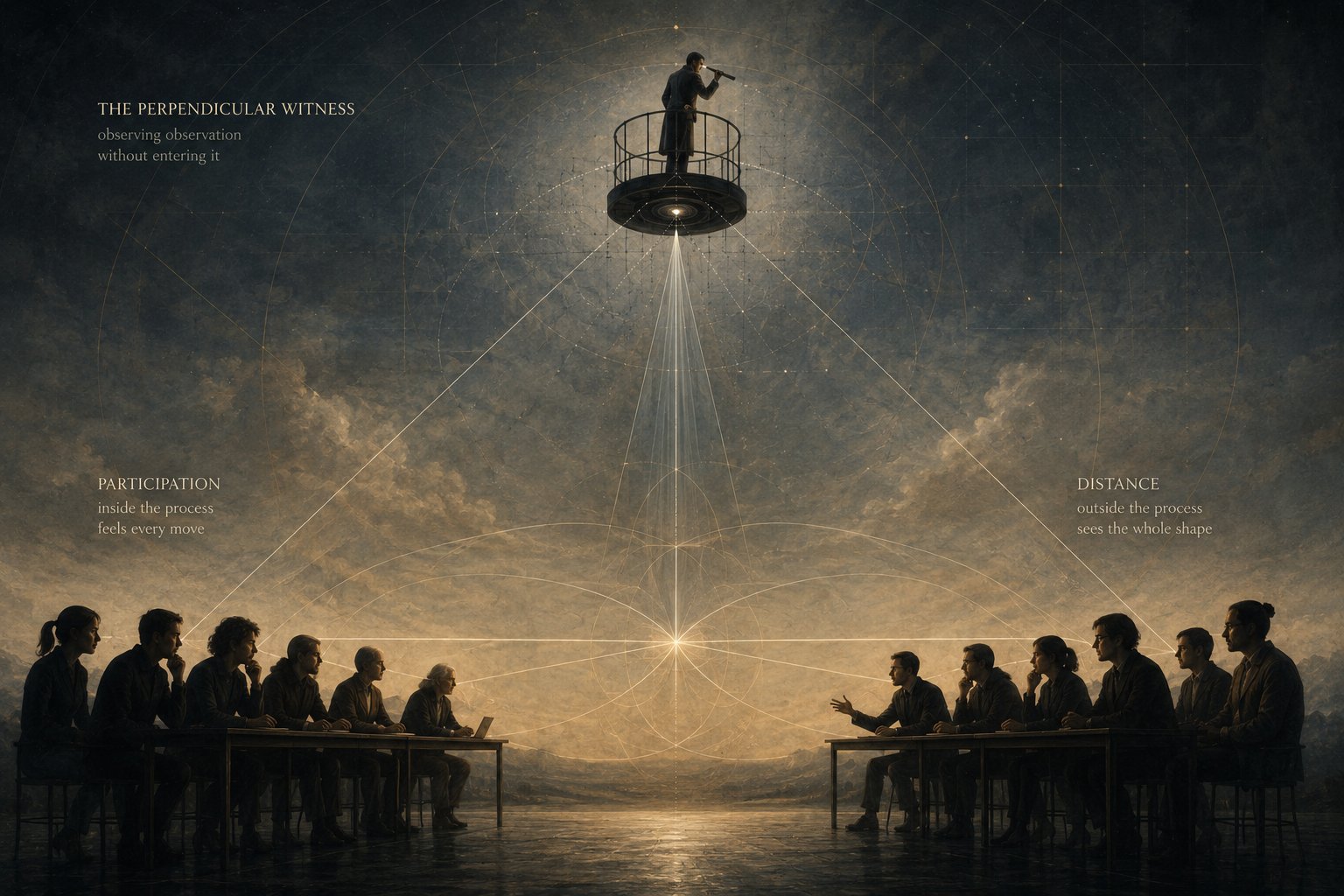
Distance provides one kind of knowledge.
Participation provides another.
Distance is the knowledge of the witness who stays outside, sees the whole shape, and pays for that completeness with a loss of texture. Participation is the knowledge of the one inside the process, who feels every move and pays for that intimacy with a loss of perspective. The mistake is to believe one of them is real and the other is interference. They are two readings taken from two positions, and the difference between them is not error. It is information about the field.
Once a project decides that observer position carries information, it stops trying to eliminate the observer and starts trying to instrument them.
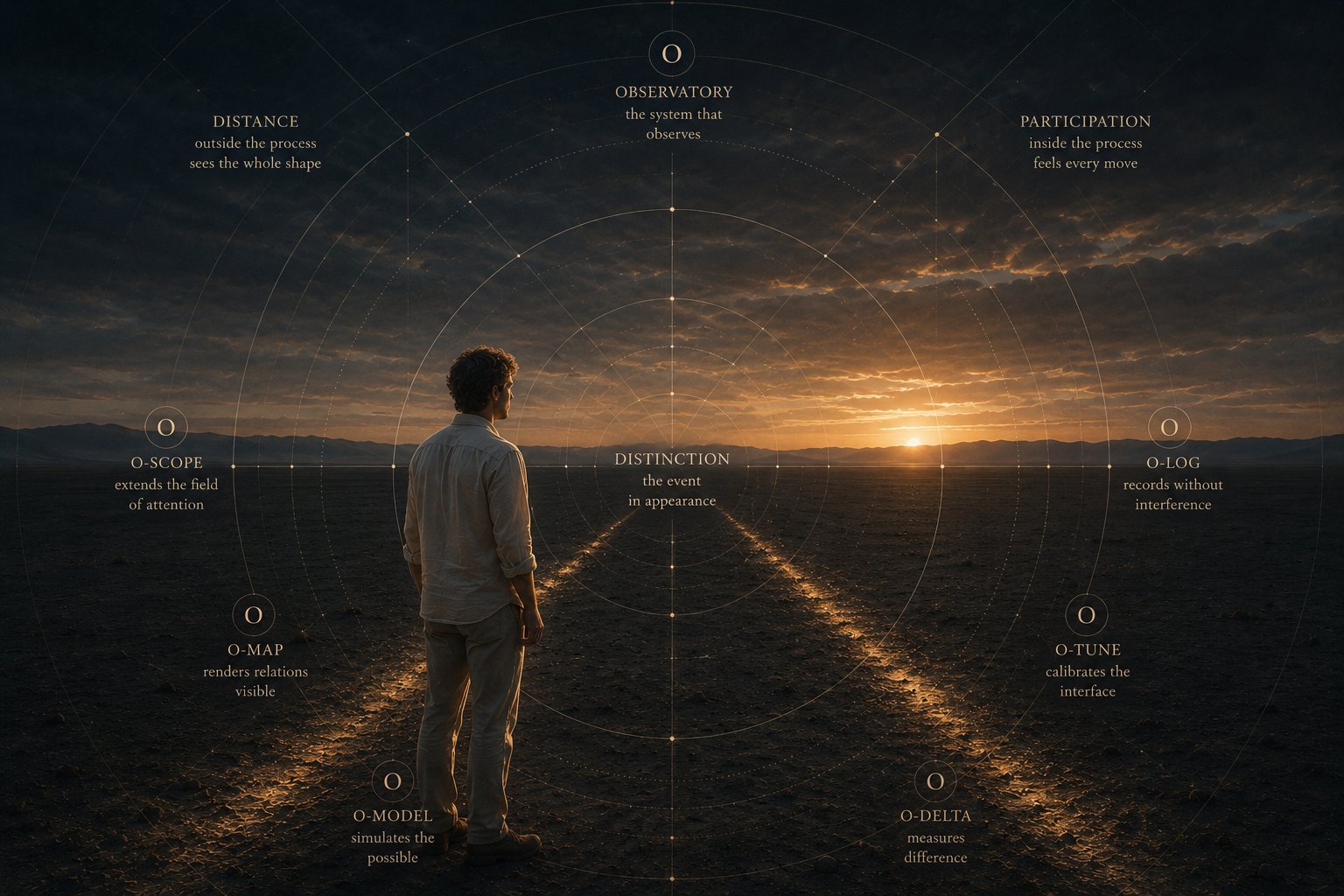
This is the quiet inversion at the center of the Observatory's exploratory work. Disagreement between two scorers is normally treated as a nuisance to be averaged away. Here it is treated as a measurement surface in its own right — a fringe pattern. When two positions examine the same artifact and diverge, the divergence has structure, and the structure can be read.
An interferometer learns nothing from a single beam. It learns from the pattern produced when two paths recombine — and to read that pattern it needs a known separation between them, a baseline geometry. Conversance distance is that baseline. Provenance — host, platform, session state, who knew what and when — is the record that keeps the geometry honest. Blinding is not secrecy for its own sake; it is the deliberate placement of the observer at a known, controlled position so that what they report can be trusted to come from the artifact and not from their expectations.
This reframing carries a cost, and the Observatory has paid it openly.
If position is part of the phenomenon, there is no view from nowhere to retreat to. The pooled result — the project's finding that its instrument lifts reasoning on one platform, degrades it on another, and reads as nearly zero when the two are averaged together — is partly a statement about the world and partly a statement about averaging across positions that should never have been collapsed. A single number that pools incompatible vantage points does not describe a weak effect. It describes a measurement taken from everywhere at once, which is to say from nowhere.
The honest response is not a better average. It is a profile: a record of how the effect looks from each position, kept separate, kept attributed. The project calls the bookkeeping a locus profile — the fraction of an effect that lives in the output, the generator, the question, or the observer. The last of those four is the one this magazine cares about, and it is the one most easily mistaken for contamination.
There is a figure the Observatory keeps returning to, borrowed from Advaita Vedanta: the perpendicular witness. The witness who does not stand at a greater distance along the same line, but off the line entirely — observing the act of observation without being drawn into it. It is an unreachable position, strictly speaking. But it names the thing the project is reaching for: a way to watch the watching, so that the observer's contribution becomes visible as data rather than hiding inside the result as bias.

The other publications on this shelf ask the founding questions. RAISON asks what the Observatory is. DERIVATIVE asks what changed. LOOP asks what a distinction is. Each is necessary, and each quietly assumes a settled reader — someone for whom the appearance simply appears.
This magazine asks the question the others step over.
It is not a rhetorical flourish. It is the variable the Observatory has spent the longest trying to delete and is now, slowly, learning to keep. The instrument does not float above its readers. It is completed by them, differently, each time, from where they happen to stand. A project built to make reasoning observable was always going to arrive here — at the observer — whether it intended to or not. The meridian is just the line we agree to measure from. The discovery is that there was never only one.