
Every intellectual project eventually encounters a moment of embarrassment. The moment arrives when the thing everyone thought they were studying turns out not to be the thing they were studying at all. Astronomy experienced it when Earth stopped being the center of the cosmos. Biology experienced it when species stopped being fixed categories. Economics experiences it every few decades. The Observatory of Structured Reasoning appears to be experiencing it now.
For much of its existence, the Observatory believed it was studying reasoning. That is no longer entirely true. Increasingly, it appears to be studying distinctions.
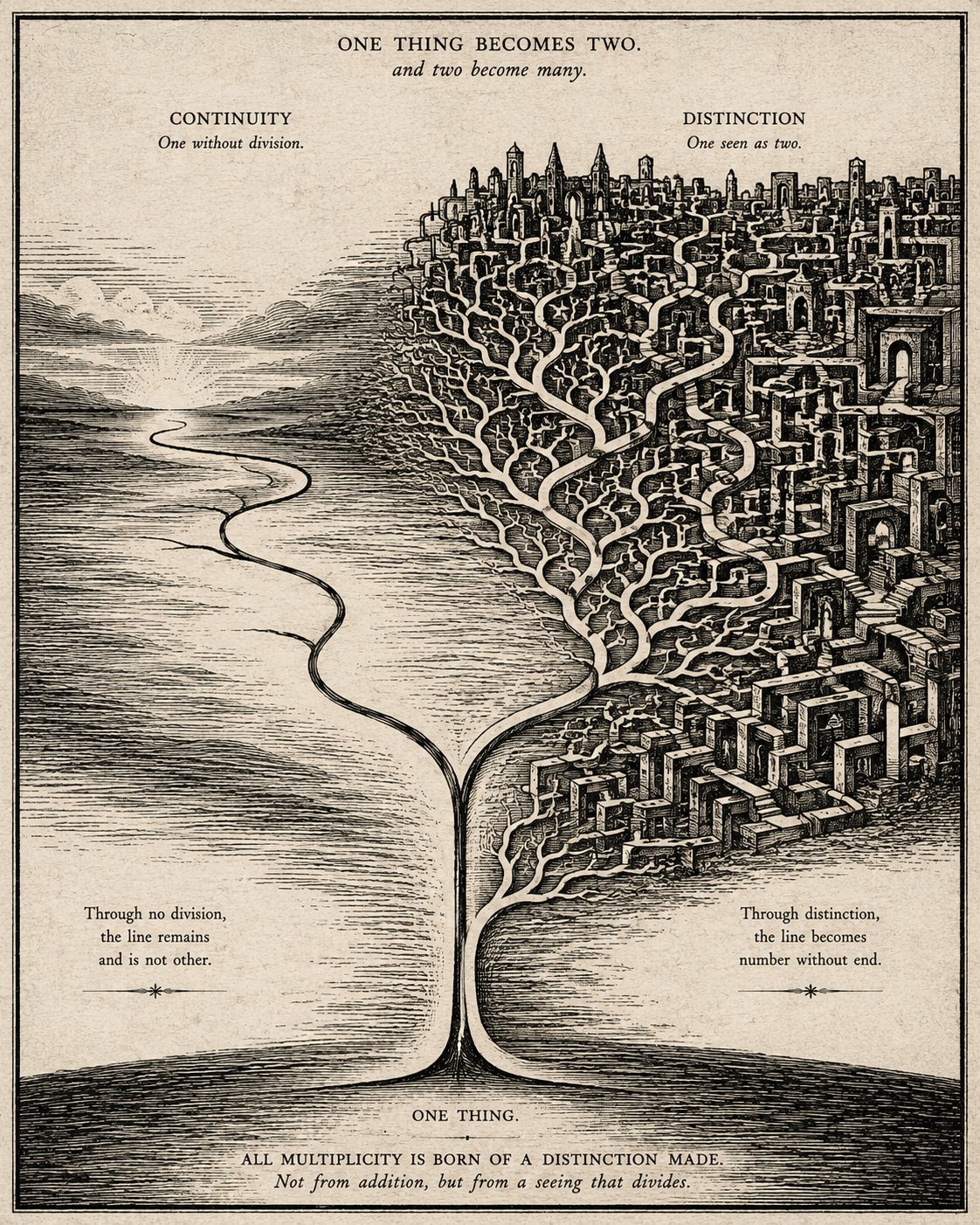
This may sound like an insignificant shift. It is not. The difference between a thought and a distinction is subtle. A thought is content. A distinction is structure. A thought says something. A distinction changes something.
The Observatory's archives contain an unusually revealing side-quest. It began with a question about evaluation. Then it became a question about ideas. Then concepts. Then observers. Eventually the participants found themselves staring at a possibility they had not intended to investigate:
What if thought is not the beginning? What if distinction is?
The proposal emerged almost accidentally.
Observation → Distinction → Thinking → Thought → Idea → Concept
The sequence appears innocent until one notices what has happened. For centuries, Western intellectual culture has tended to treat thought as primary. Thought generates ideas. Ideas generate concepts. Concepts generate systems. The Observatory's proposal reverses the order.
A distinction occurs first. Something changes. Only afterward does thought emerge as a consequence. This is not a claim about psychology. It is a claim about structure.
A distinction is the smallest event capable of reorganizing understanding. It is the moment one thing becomes two things. Before the distinction, there is continuity. After the distinction, there is difference. Everything else follows.
The implications are strange. If distinctions come first, then many familiar intellectual objects become secondary phenomena. Thought becomes the residue of distinctions. Ideas become stabilized distinctions. Concepts become institutionalized distinctions. Knowledge itself begins to resemble an ecology of distinctions that have survived long enough to become durable.
Seen from this perspective, reasoning changes character. Reasoning is no longer primarily the production of answers. It becomes the management of distinctions.
The Observatory's recent work repeatedly circles this possibility. WHITMAN introduces distinctions. R-Delta measures distinctions that become visible. ALPHA evaluates the effects of distinctions. Xi studies the behavior of distinctions across observers. Even the Observatory's newer ontology appears to converge on the same point. Again and again, the object of study moves away from answers and toward the transformations that make answers possible.
The project's participants eventually stumbled into a realization that may prove more important than any benchmark result. The distinction itself may be the primitive. Not the answer. Not the thought. Not even the observer. The distinction.
This would explain why the Observatory repeatedly finds itself fascinated by things that seem peripheral to reasoning. Figure and ground. Signal and noise. Observer and observed. Question and answer. These are all distinctions.
The project's archives contain another revealing phrase:
The sentence appears in a discussion about figure and ground. Yet it feels increasingly like a description of the Observatory itself. Native and WHITMAN. Question and observer. Signal and measurement. The distinction matters. The separation is often an illusion.
Perhaps this is what institutions dedicated to observation eventually discover. The telescope does not merely reveal stars. The microscope does not merely reveal cells. The distinction reveals the world.
And once seen, the recursion begins.
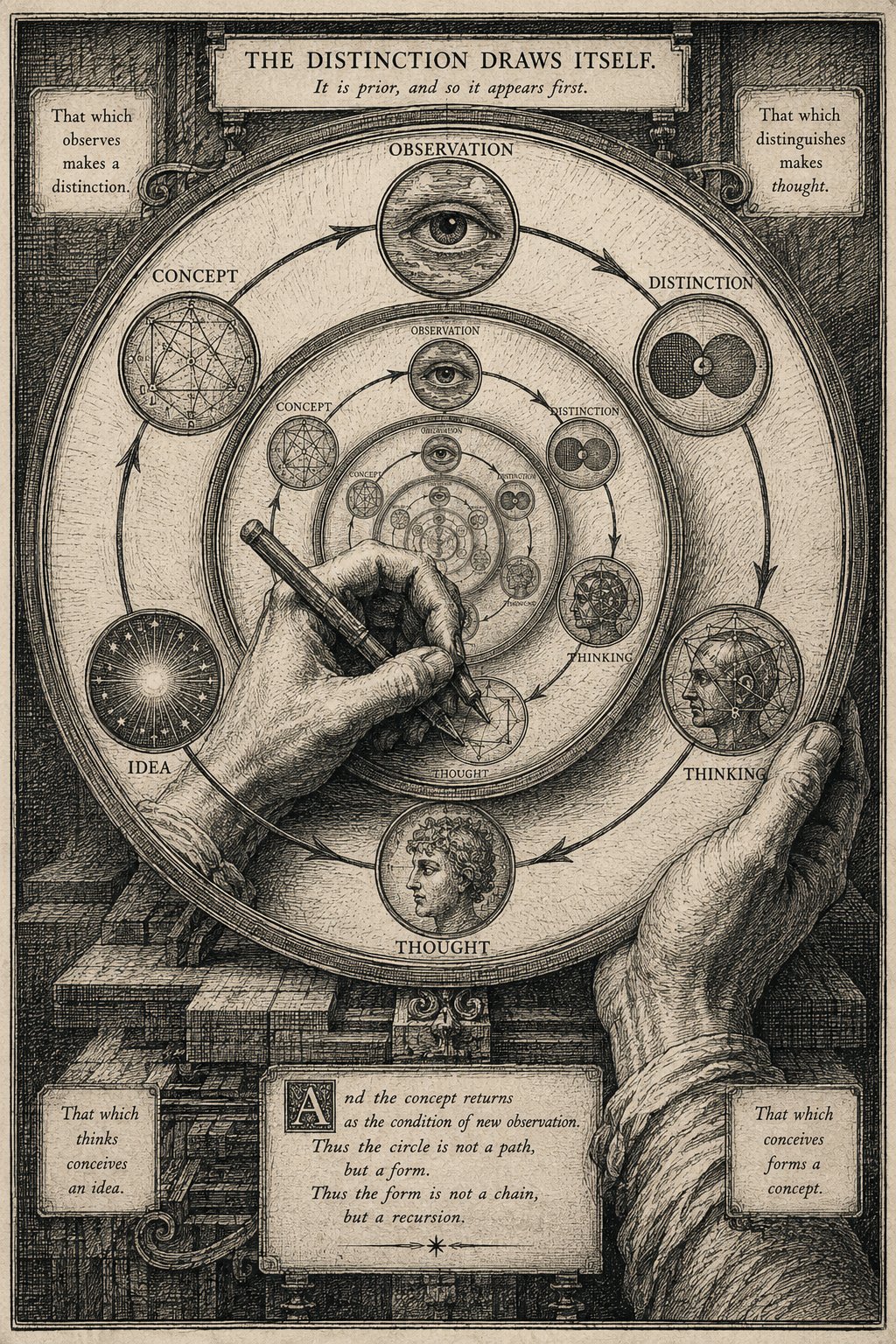
Observation → Distinction → Thought → New Distinctions → Observation
Observation produces distinction. Distinction produces thought. Thought produces new distinctions. The loop closes. The loop continues. The loop never ends.