
Every scientific instrument begins with a simple question. The telescope asked what could be seen at a distance. The microscope asked what could be seen at a small scale. The Observatory of Structured Reasoning appears to be asking a stranger question:
At first glance, this sounds like a philosophical concern rather than a scientific one. Yet the Observatory's recent work suggests that it may be possible to treat such appearances as measurable phenomena rather than purely subjective experiences.
The concept is called R-Delta.
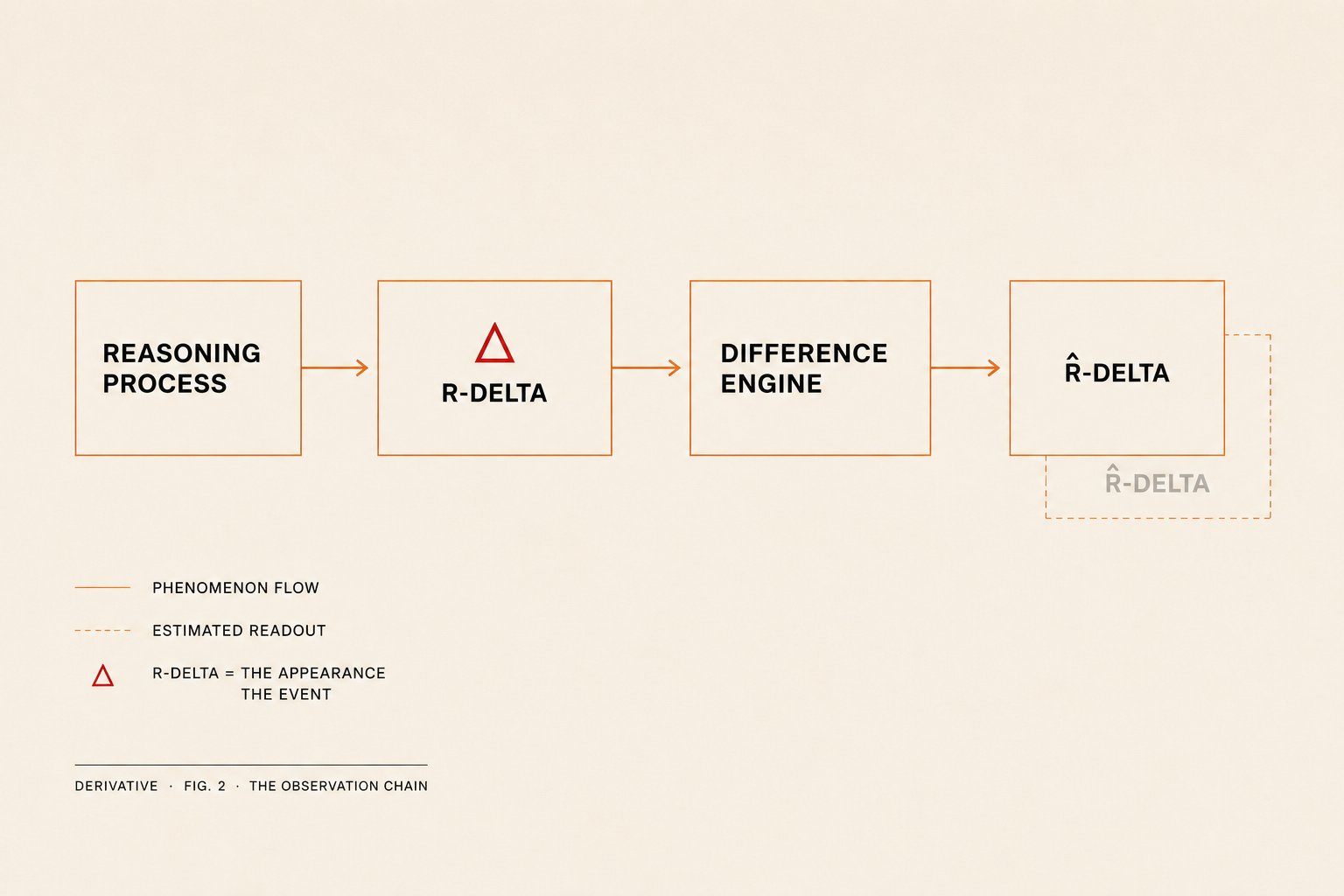
The name began in the project's earlier language as Revelation Delta: the increase in accessibility of a distinction. The current locked definition is more exact. R-Delta is the latent reasoning effect produced by distinctions.
The change matters. It moves R-Delta away from mystical revelation and toward measurement. What matters is not certainty, prophecy, or final truth. What matters is the effect produced when a distinction changes reasoning.
R-Delta (ΔR) = latent reasoning effect produced by distinctions
R̂-Delta = scorer's estimate of R-Delta
R̂-Delta ≠ R-Delta
Difference Engine = ALPHA + Scorer + Protocol
The name emerged from a deceptively simple observation. When two people encounter the same question through different reasoning processes, they often produce different answers. Traditionally, evaluation focuses on determining which answer is correct, useful, persuasive, or elegant.
The Observatory became interested in a different possibility: what if the most important thing was not the answer itself, but the difference between them?
Not all differences are equal. Some are stylistic. Some are organizational. Some are little more than paraphrase. Others reveal something that neither answer makes obvious on its own.
That distinction is intentionally agnostic about source. The distinction may have been latent in the question itself. It may have been introduced by the reasoning process. It may have emerged through interaction between question, observer, and instrument.
R-Delta does not settle where the appearance came from. It marks that something appeared, then asks whether that appearance changed reasoning.
This proved surprisingly important. Earlier versions of the Observatory's work treated reasoning systems as the primary object of study. The question was whether a framework called WHITMAN produced better answers than a native response.
Over time, that framing became unstable. Researchers repeatedly encountered situations where the interesting phenomenon was not the framework, but the appearance produced by the framework. The object of observation quietly shifted. The benchmark was no longer measuring WHITMAN. It was measuring the difference.
Eventually the idea was formalized through a simple ontology:
Reasoning Process → R-Delta → Difference Engine → R̂-Delta
phenomenon → apparatus → estimate
The distinction between the middle two layers is subtle but important. R-Delta is the phenomenon. R-hat Delta is the estimate.
The difference resembles the distinction between a star and the telescope observing it. A telescope does not create the star. It produces an estimate of the star. Likewise, the Observatory's measurement apparatus does not create R-Delta. It attempts to detect and estimate it.
This realization transformed the project.
A benchmark asks a familiar question: which answer won? A measurement science asks a different one: how reliable is the instrument claiming that one answer won? That shift may be the most significant development in the Observatory's history.
The project increasingly resembles a scientific effort devoted to distinctions themselves.
Questions become environments. Observers become instruments. Answers become evidence. Differences become phenomena.
The implications are surprisingly broad. If R-Delta exists as a measurable phenomenon, then reasoning systems can no longer be understood solely through outputs. They must also be understood through the distinctions they make visible, the assumptions they expose, and the structures they reveal.
The answer becomes only one artifact among many.
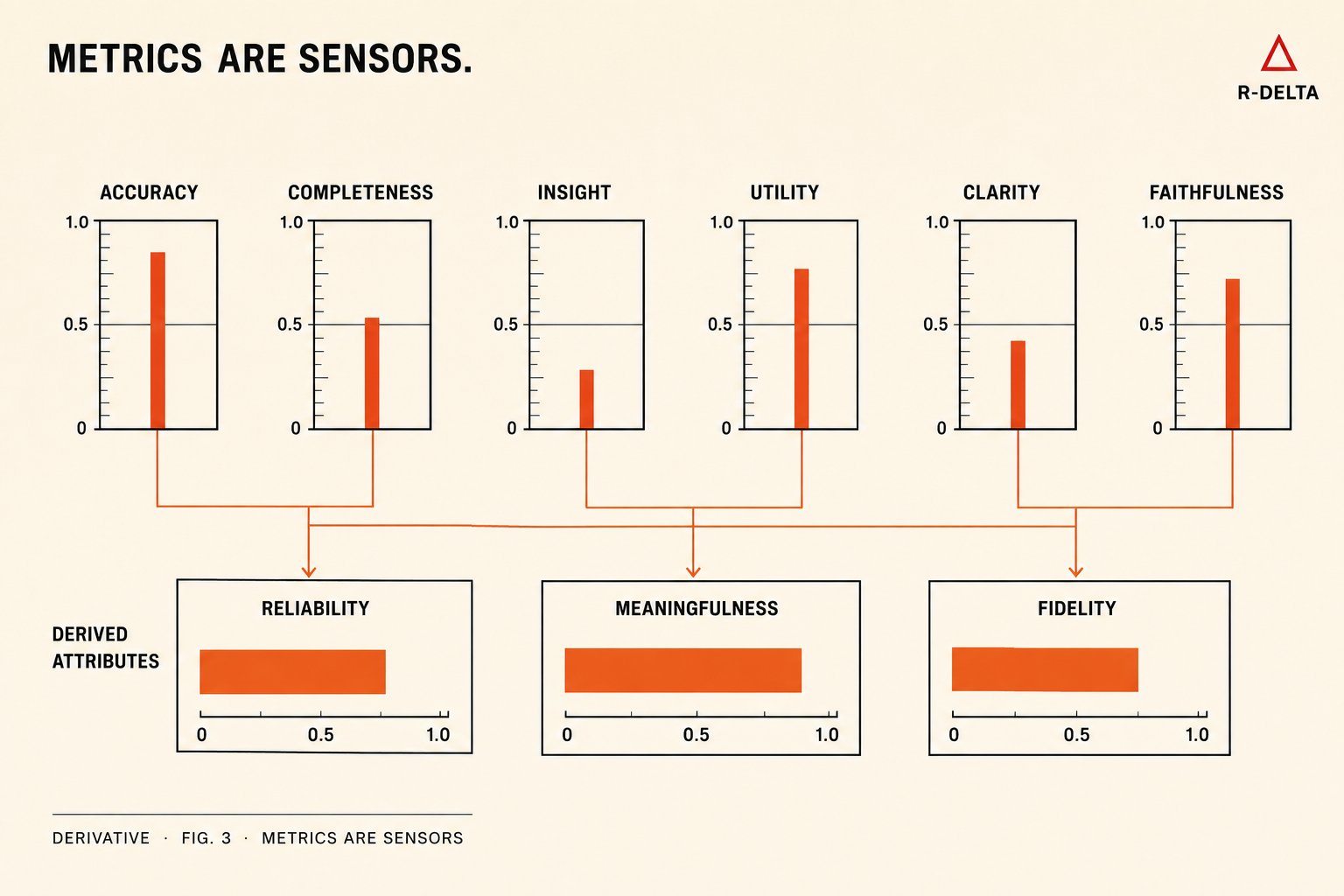
This is also why the Observatory's measurement language has moved toward profiles and attributes rather than a single winning score. The source equations treat individual metrics as projections, then compress them into derived attributes that describe system behavior.

Analytical Power = Accuracy + Completeness + Insight
Strategic Value = Insight + Practical Utility + Frame Awareness
Transformative Capacity = Insight + Frame Awareness
Communication Quality = Completeness + Clarity
In other words: metrics are sensors. The thing one actually wants is a small number of attributes that describe the system.
The word revelation still matters historically. It names the moment when the project first realized it was studying appearance rather than answer quality. But the mature phenomenon is not revelation as certainty. It is visibility under measurement.
A hidden assumption becoming visible. A suppressed constraint becoming visible. A question behind a question becoming visible. The phenomenon is not certainty. The phenomenon is appearance. Whether that appearance is ultimately judged correct remains a separate question.
In an era increasingly occupied with artificial intelligence, many institutions are attempting to make machines more intelligent.
The Observatory appears to be pursuing a different ambition. It is attempting to make reasoning itself more observable. R-Delta may prove to be the first instrument built for that purpose.