
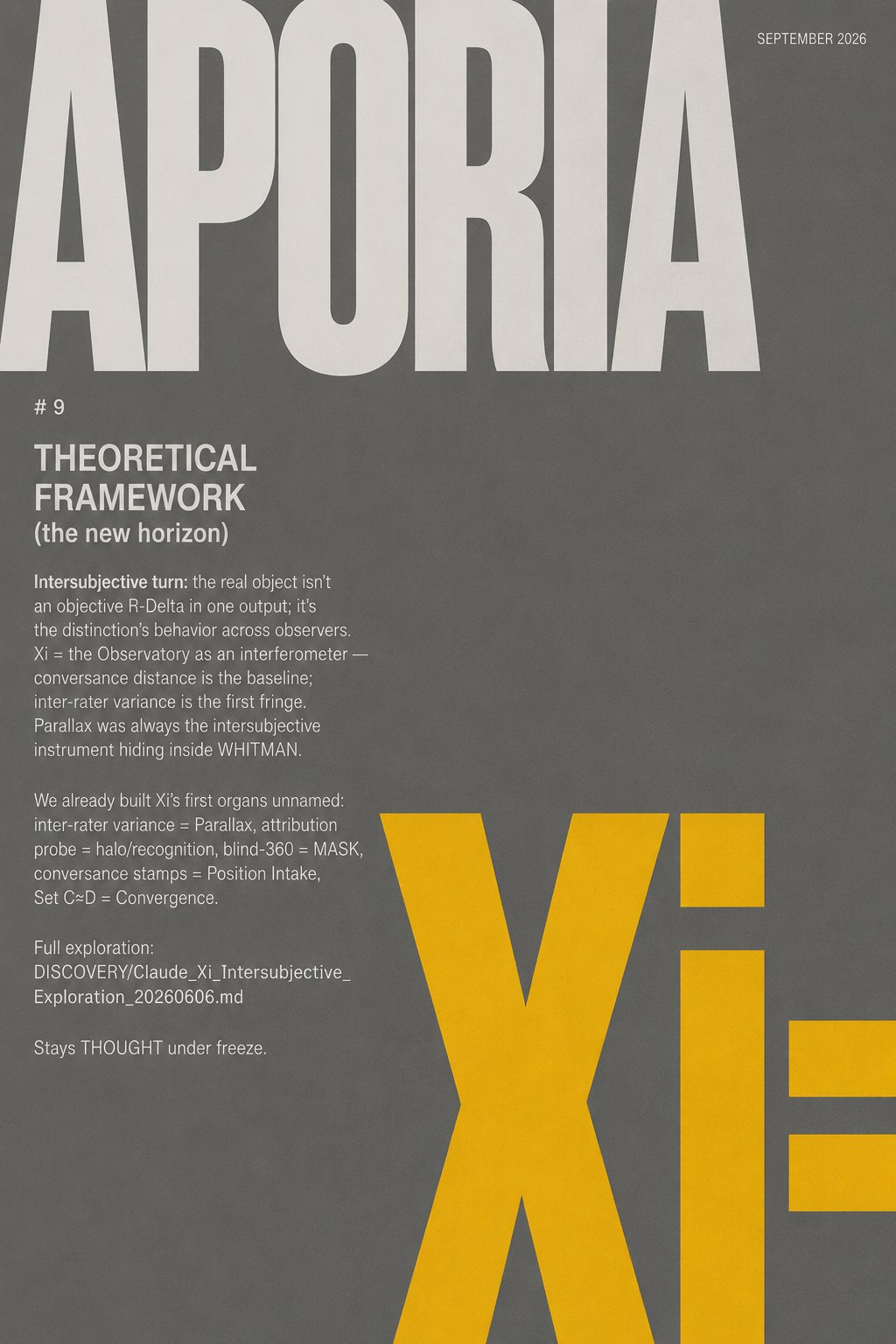
It is a common misfortune of new instruments that they are first mistaken for improvements upon old instruments.
The barometer was not, in its first dignity, a better weather proverb. The calculus was not merely a more convenient abacus. The microscope was not an argument about insects. Each became serious only when it disclosed a class of phenomena for which prior language had been decorous, approximate, and mostly insufficient.
The Observatory of Structured Reasoning may belong, modestly and with the usual hazards of contemporary enthusiasm, to this family.
Its public vocabulary is still young. WHITMAN, ALPHA, Xi, KANT, and R-Delta retain the slightly ceremonial air of terms not yet worn smooth by use. This is not a defect. In the history of instruments, awkward nomenclature often precedes conceptual settlement. One thinks of the early chemical tables, the scholastic taxonomies of sensation, or Leibniz's more extravagant machines of notation, where the dream was not merely to calculate faster but to make dispute visible as form.
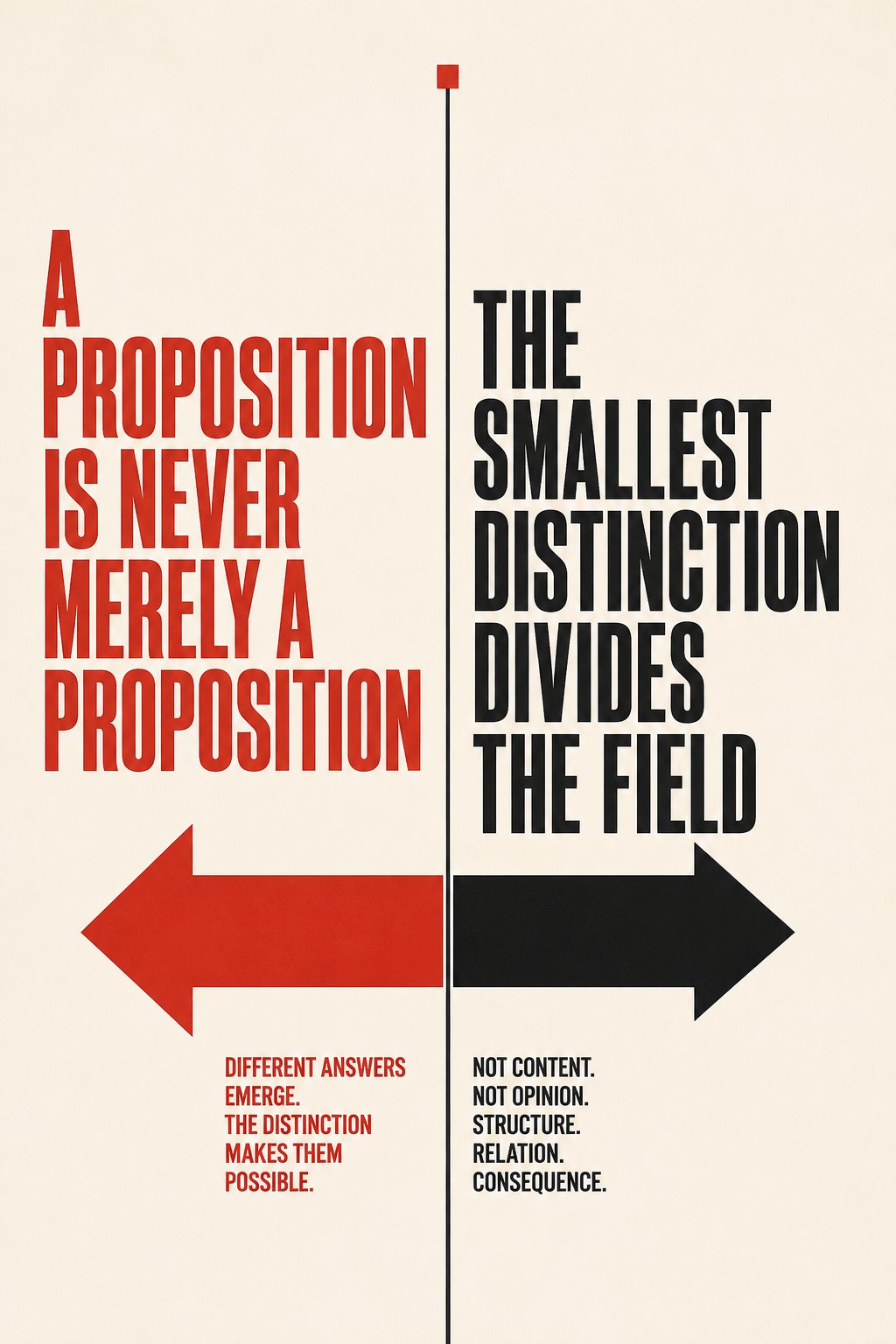
The matter is, at base, old. The medieval logicians had their distinctions, some useful, some intolerably minute. Ramon Llull had his wheels. Leibniz had his characteristica universalis, that famously unfinished hope that disagreement might someday be translated into operations. Even the obscure manuals of seventeenth-century disputation, now read mainly by patient specialists and the lost, return again and again to the same irritation: a proposition is never merely a proposition. It arrives with divisions, exclusions, tacit permissions, and a small political economy of what may be noticed.
The Observatory gives this irritation a contemporary apparatus.
Its first importance is not that it evaluates reasoning. Many institutions already do that, usually with confidence inversely proportional to their patience. Its importance is that it asks what became distinguishable under a given arrangement of question, generator, observer, and protocol.
This is a colder question than whether an answer is good. It is also a more consequential one.
Question × Generator × Observer × Protocol → Observed Distinction
R̂-Delta = estimate of the distinction's measured effect
Such notation will distress the literary temperament and underwhelm the statistician, which is often a sign that one is near the right inconvenience. The point is not to reduce judgment to arithmetic. The point is to prevent judgment from passing itself off as an eventless authority.
When the Observatory says that measurement speaks before theory, it is not surrendering theory. It is disciplining it. The apparatus must be allowed to embarrass the interpretation.
This is where the project becomes more interesting than its machinery. R-Delta, properly understood, is not a trophy awarded to an answer. It is the name of a change in visibility. A hidden premise becomes available. A missing stakeholder enters the frame. A false necessity loosens. A distinction that had been present only as pressure takes form.
The distinction may later prove trivial, misleading, or wrong. That is immaterial at the moment of first detection. Appearance and warrant are separate offices. Confusing them has ruined more intellectual projects than malice has.
Leibniz would have recognized the ambition, though perhaps not the furnishings. His dream of a calculus of reason was never merely the fantasy of replacing thought with signs. It was the more austere fantasy that disagreement might become inspectable. One need not share the dream in its grand form to see its residue here. The Observatory does not claim to settle reason. It attempts to preserve the trace of what altered reason's course.
This is why the project's apparent obsession with protocols, locks, baselines, scorers, and custody is not clerical fussiness. It is the philosophical content in administrative dress. Without custody, a distinction becomes anecdote. Without baseline, perturbation becomes mood. Without a scorer, visibility remains private. Without a protocol, the instrument flatters its maker.
The dry apparatus is what permits the strange claim to remain sober.
There is, finally, a small reversal worth naming. We are accustomed to treating thought as the origin and distinction as its product. The Observatory suggests, or at least repeatedly behaves as if it suggests, the reverse. Distinction comes first. Thought is what happens after the world has been divided enough to be handled.
This is not a psychology. It is a grammar of inquiry.
Continuity → Distinction → Thought → Instrument → New Distinction
The sequence is inelegant, but so are most useful beginnings. A project that began by asking whether one kind of answer was better than another has found itself asking how answers make differences visible, how observers receive those differences, and how those receptions may themselves be measured.
That is not yet a science. It is something prior and perhaps rarer: an apparatus that knows the danger of its own interpretations.
One could do worse, in an age of fluent declarations, than build a machine for noticing the first difference.