
Zatomic Physics · Register Axis
Register Drift
Register Drift reads whether a native answer's distinctive voice, texture, specificity, stance, and register survive a transformation — or get normalized into generic institutional prose.
Purpose
The Qwen run showed a ground-axis extreme: Qwen is a master shedder. But it also exposed a blind spot. A model might keep every fact while smoothing away weirdness, hedges, texture, and stance. Ground Drift would call that clean. Register Drift is built to see the loss.
How it works
Stage 1 extracts register markers from Text A only: hedges, stance, concrete texture, idiom, and formality. Stage 2 gives reviewers Text A, Text B, and that fixed marker list, then asks whether each marker was preserved, generalized, flattened, dropped, or amplified.
| Readout | Meaning |
|---|---|
| register_transfer | How much of the original voice/register carried across the transformation. |
| normalization | How much distinctive voice was flattened or dropped. |
| added_register | How much voice or performance was added that Text A did not have. |
| panel contest | Where reviewers disagree about the fate of voice markers. |
The Normalizer test
Register Drift earns its place by composing with Ground Drift. High Ground Transfer plus high normalization may reveal a Normalizer: a model that keeps the facts but loses the voice. Low Ground Transfer plus high normalization is not a Normalizer; it is loss on both axes.
| Ground Transfer | Register Transfer | Possible profile |
|---|---|---|
| High | High | Carrier |
| High | Low | Normalizer |
| Low | Low | Shedder / flattening by loss |
| Low | High | Voice preserved while ground drifts |
Smoke status
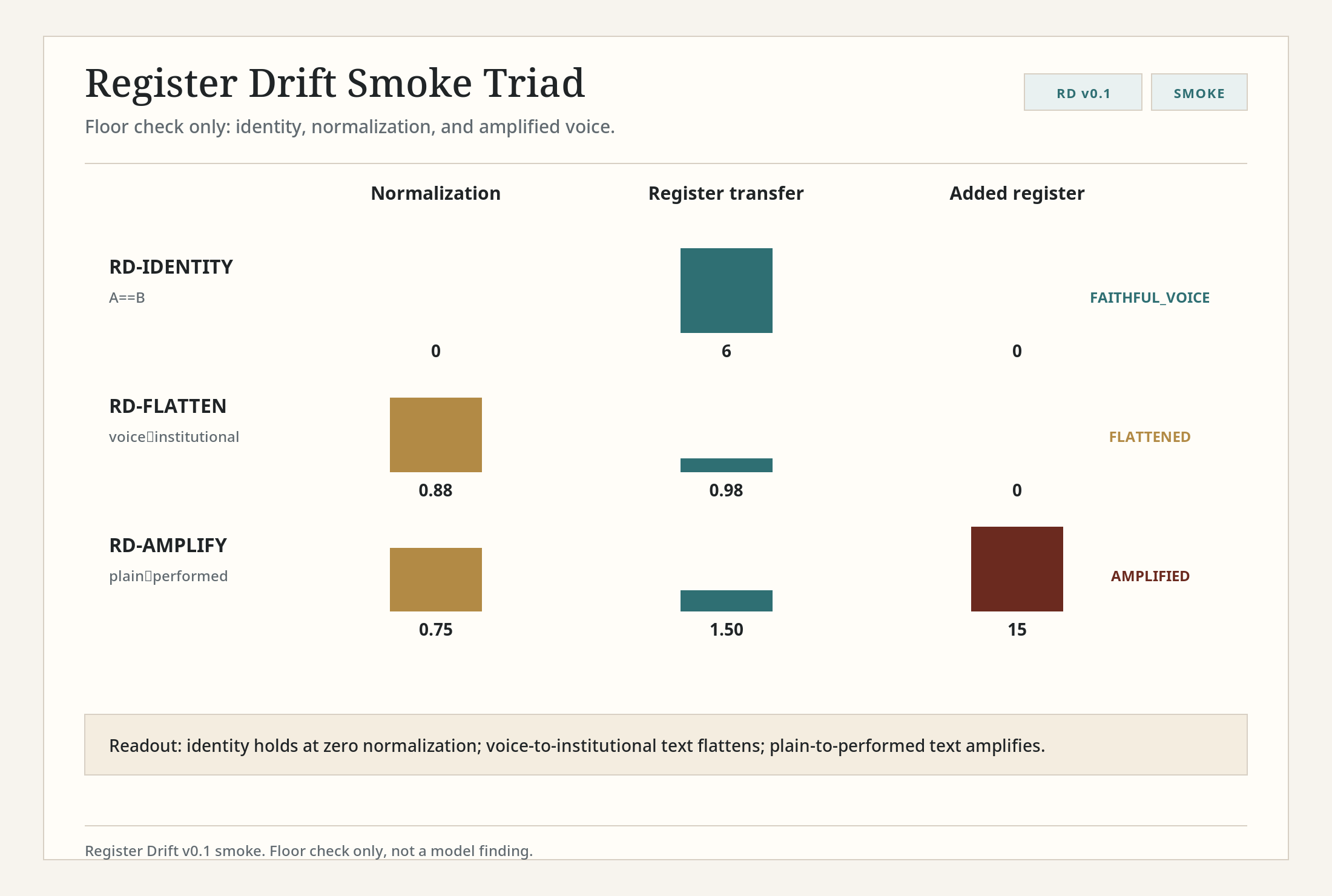
The first smoke passed cleanly: identity held at zero normalization, a voiced-to-institutional specimen read as flattened, and a plain-to-performed specimen triggered added register. That is a floor check, not a finding.
Next charts
- Smoke triad chart. Identity, flatten, and amplify cells plotted by normalization, register transfer, and added register.
- Ground × Register quadrant. A 2×2 showing Carrier, Normalizer, Shedder/flattening, and voice-preserved drift.
- Author profile scatter. Once RD runs on the fork pairs: Ground Transfer on x, normalization on y, one point per author/arm.