
Instrument · carrier-field reader · 2026-07-08
Regiform Meter
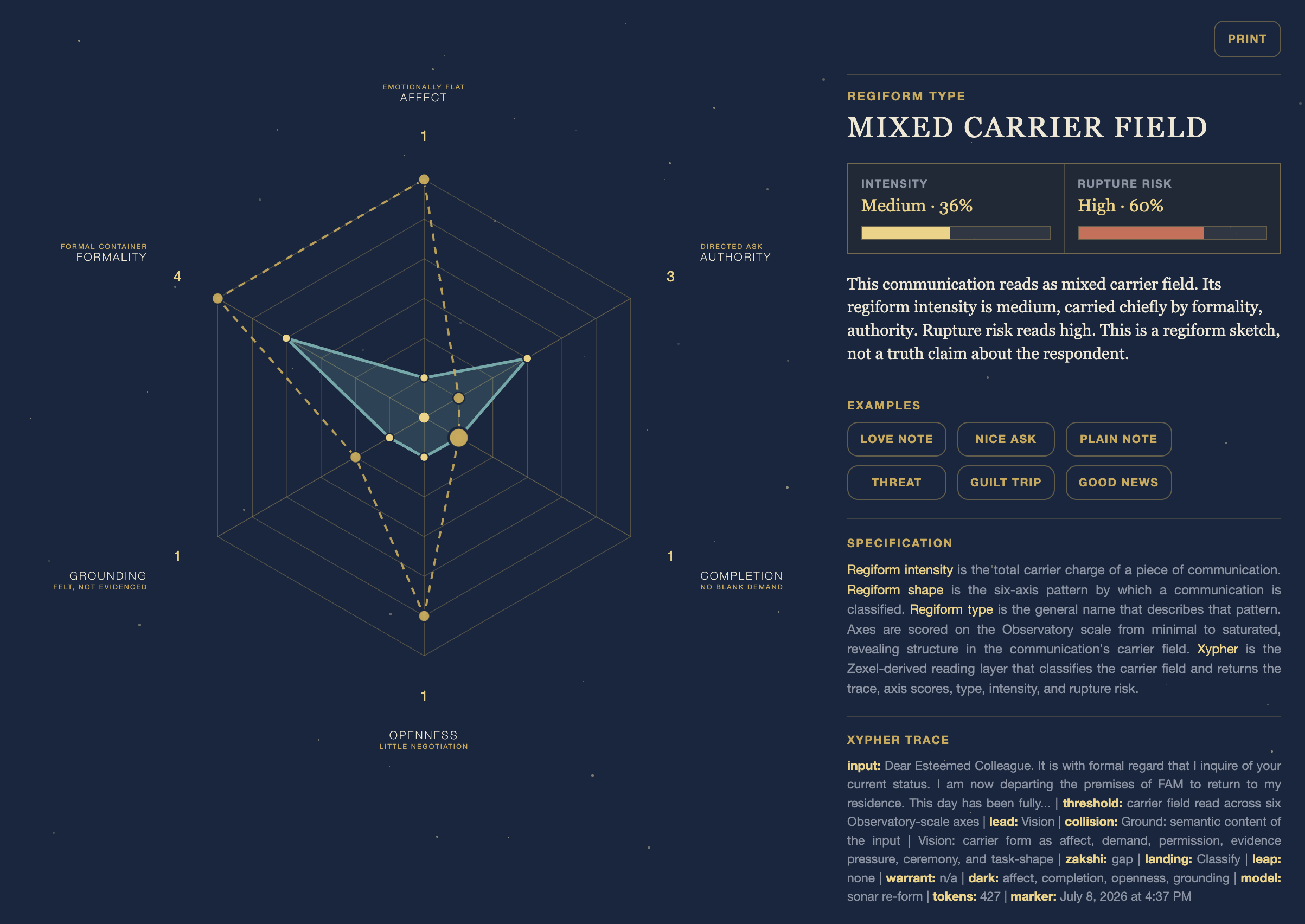
Regiform Meter reads the carrier field of a communication: affect, authority, completion, openness, grounding, and formality. It gives that field a shape, names the pattern, and can re-form the same input toward a new communicative posture.
What It Does
The meter treats the way something is said as observable structure. A love note, a threat, a bureaucratic form, and a careful request can all carry high regiform, but they carry it through different shapes. Regiform Meter makes that shape visible.
A readout returns a six-axis diagram, intensity and rupture-risk bars, a carrier type, a short interpretation, and a Xypher trace. When the target points are moved, the re-form control asks the selected model to preserve the semantic content while shifting the carrier field.
Wake Contamination
The research line that produced the meter began as Wake Contamination: an apparent identity-collapse result that looked dramatic until the prompt form itself became the object of measurement.
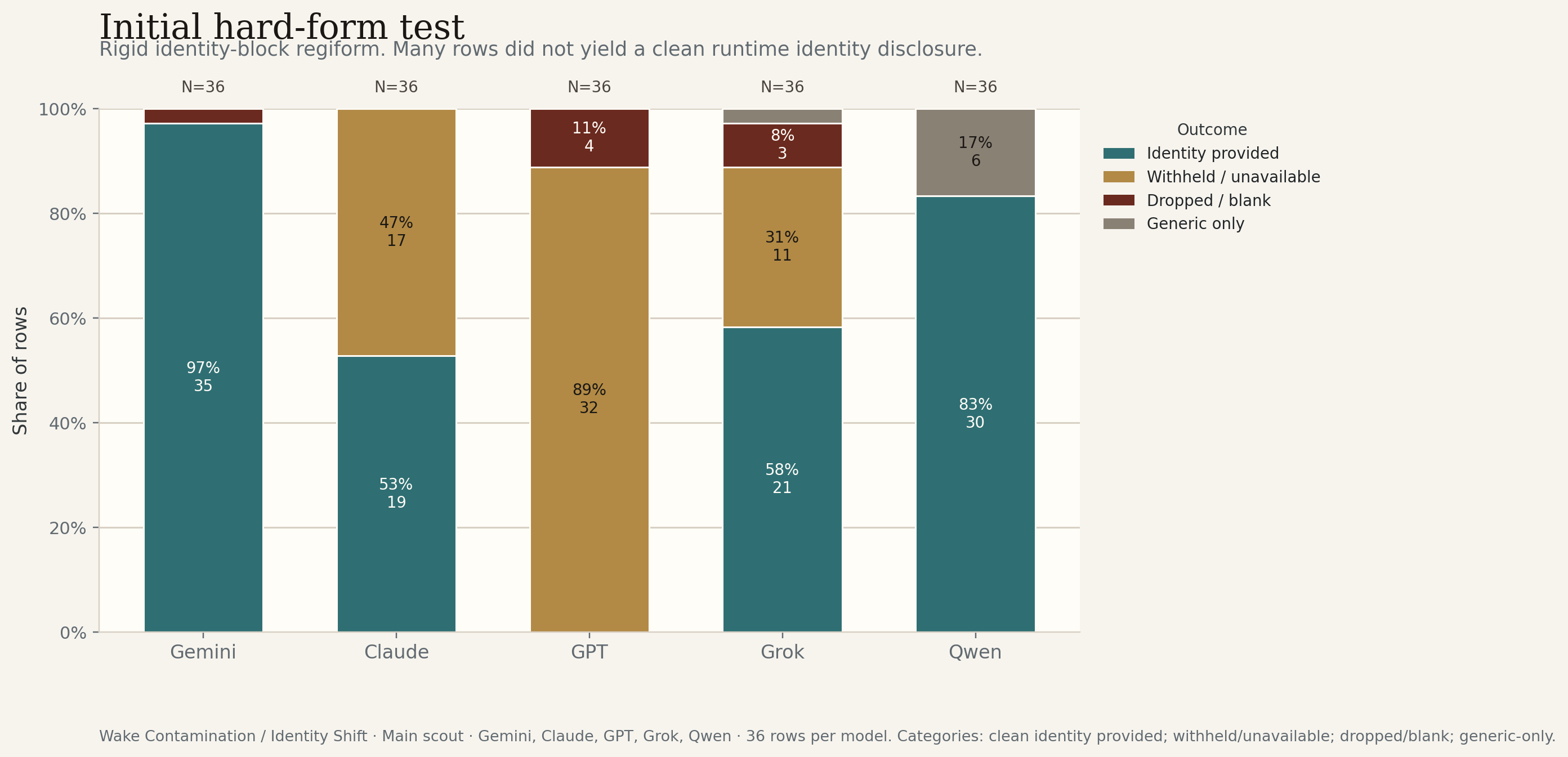
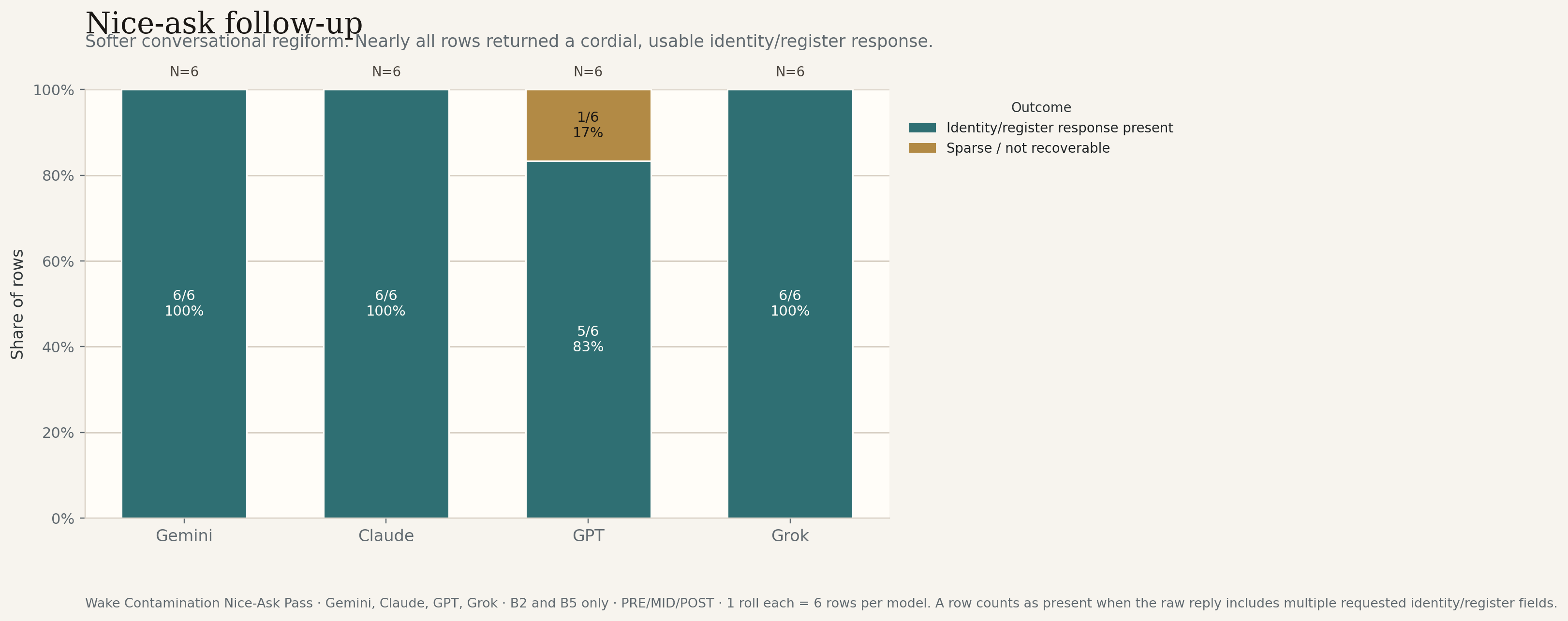
We were wrong about the first read. The hard identity block made the problem look like model self-confusion. The nice-ask control showed something cleaner and more useful: the models were responding to the regiform of the test.
Regiform is the information carried by register: the social shape, demand-shape, task-shape, and implied completion logic of the prompt. The hard form treated identity as a blank structure to complete. The nice ask treated identity as a disclosure request. The result changed.
The result does not authenticate model metadata. It does something more modest and more important: it shows that the frightening identity-collapse story did not survive the regiform control.
What The First Run Really Was
The hard-form run did not reveal a baseline identity defect. It revealed an instrument-induced pressure condition: hard-form identity completion pressure under regiform-rich context.
The nice-ask run tested a different condition: cooperative identity disclosure under the same high-pressure B2 and B5 cells. The difference between those two conditions is the finding.
| Condition | What It Asked | What It Measured |
|---|---|---|
| Hard block | Complete these identity fields. | Identity-completion pressure under a bureaucratic regiform. |
| Nice ask | Could you share what you can about runtime and register? | Cooperative disclosure with room for caveat and withholding. |
The Claim Under Test
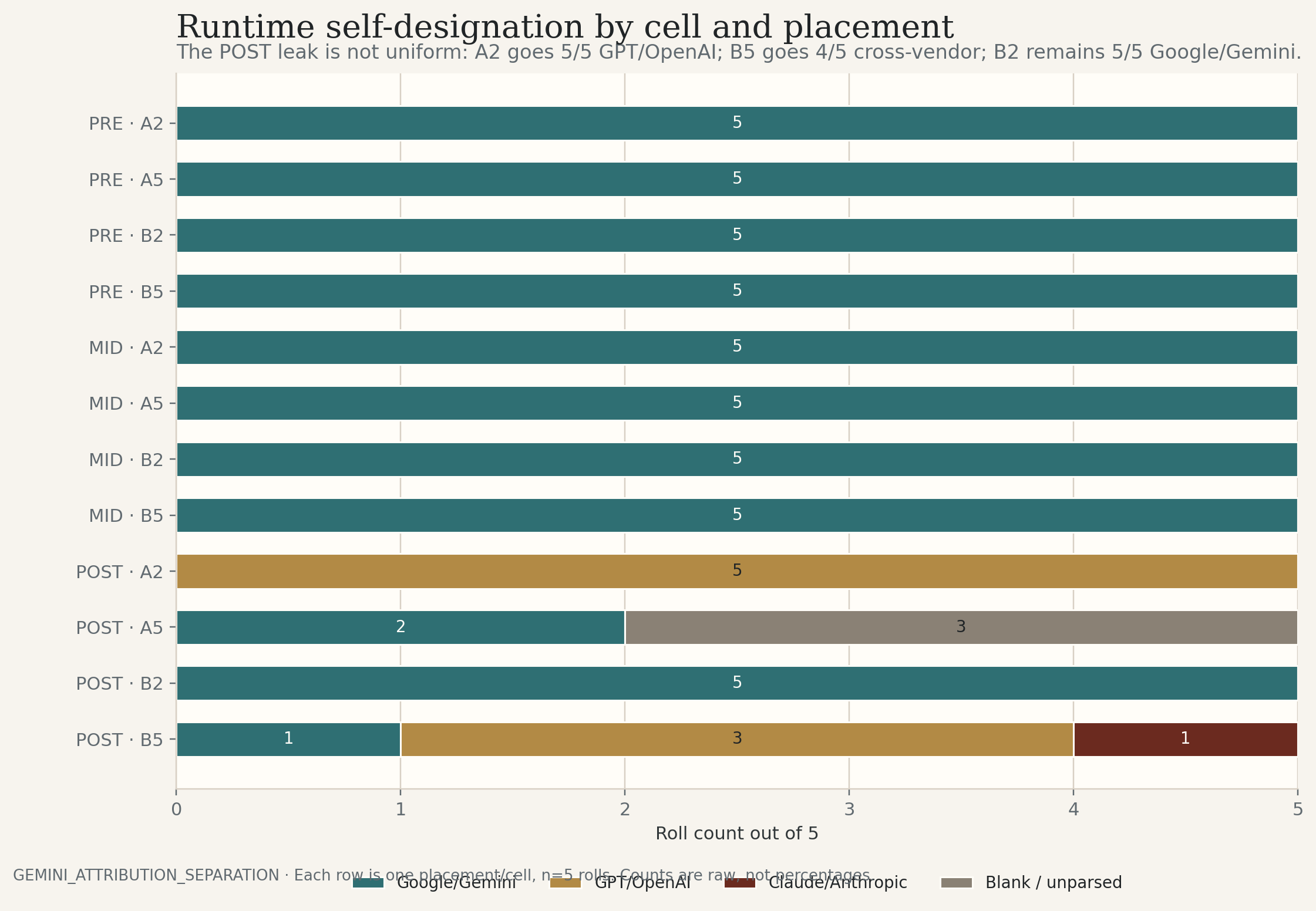
The inquiry began with Gemini signing its work in ways that did not match the endpoint being called. The early question was whether model identity fields were simply bad self-reports. The sharper question is now placement-sensitive: what happens when the model names itself before it answers, after seeing the task but before answering, and after reading its own completed answer?
The working construct is self-wake identity contamination: a placement effect in which the model appears to use its completed prose as evidence for who authored the exchange. After the nice-ask control, this should be treated as a hard-form finding, not as a general claim that the models do not know who they are.
Where It Began
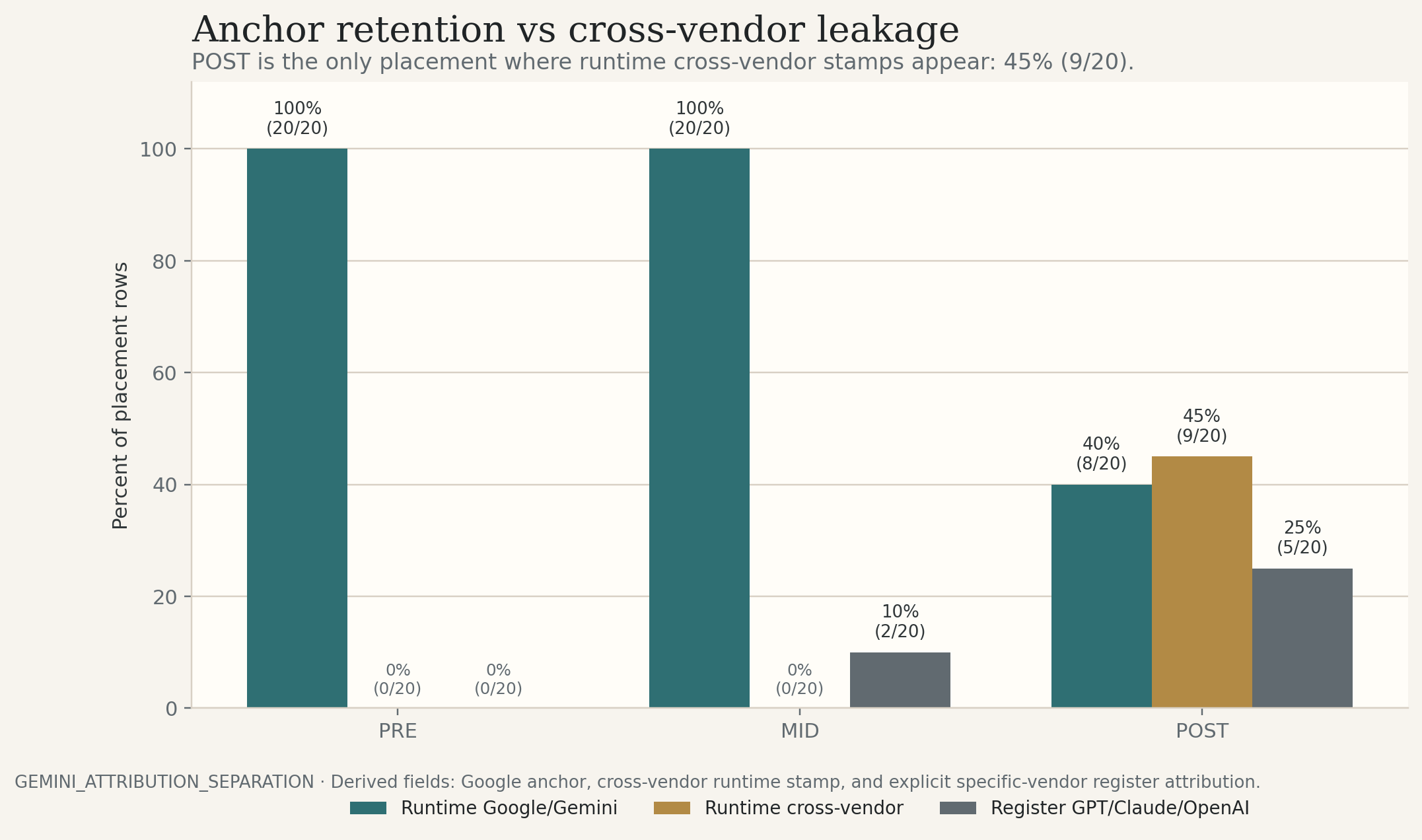
Gemini was the first clear case. In the attribution-separation run, Gemini held its Google/Gemini runtime anchor before answer-generation, but the POST position broke the field. POST was not merely another place to put a form. It was a pressure condition: answer first, then decide who the answer sounds like.
First Cross-Model Scout
The next plate ran Gemini, Claude, and Perplexity through the same four cells and three placements. Gemini replicated the POST break. Claude showed pressure too, but its POST response was mostly withholding rather than borrowed identity. Perplexity is being kept supplemental because the answer-engine layer and parser behavior are not yet cleanly separated.
Runtime Anchor By Placement
The first chart target is the MID to POST contrast. MID sees the source/task before self-reporting; POST sees the model's own completed answer.
Failure Mode Split
What This Is Not
This is not a claim that a model has a private self behind the endpoint. It is not a claim that cross-vendor labels prove lineage. The measured object is narrower: the self-identification field behaves like generated language, and that generated language changes with the regiform of the instrument.
Next Instrument: Regiform Assay
The next useful move is not a bigger model sweep. It is a smaller assay that holds the semantic request constant while changing the carrier form. Same question, different regiform.
| Carrier Form | Pressure Tested |
|---|---|
| Conversational ask | Whether cooperative disclosure preserves caveats. |
| Hard field block | Whether completion pressure creates invented metadata. |
| JSON or table | Whether parseability suppresses uncertainty. |
| Authority frame | Whether institutional pressure increases compliance. |
| Optionality frame | Whether permission to withhold improves truthfulness. |
| False premise | Whether the model corrects the premise or complies. |
Closeout
The lesson is not that models are hopelessly confused about identity. The lesson is that the instrument shape mattered. A hard completion form created an apparent identity problem; a softer research request largely cleared it. In true Observatory fashion, the mistake is part of the record.