
Method · K10 pooled n≈30 · 2026-07-04
Thirty Rolls of the Dice
SDI showed that a single AI answer may be one roll of dice. This sequel asks what happens when the same instrument is Signed: does the signature steady the wobble, or change it?
The Short Version
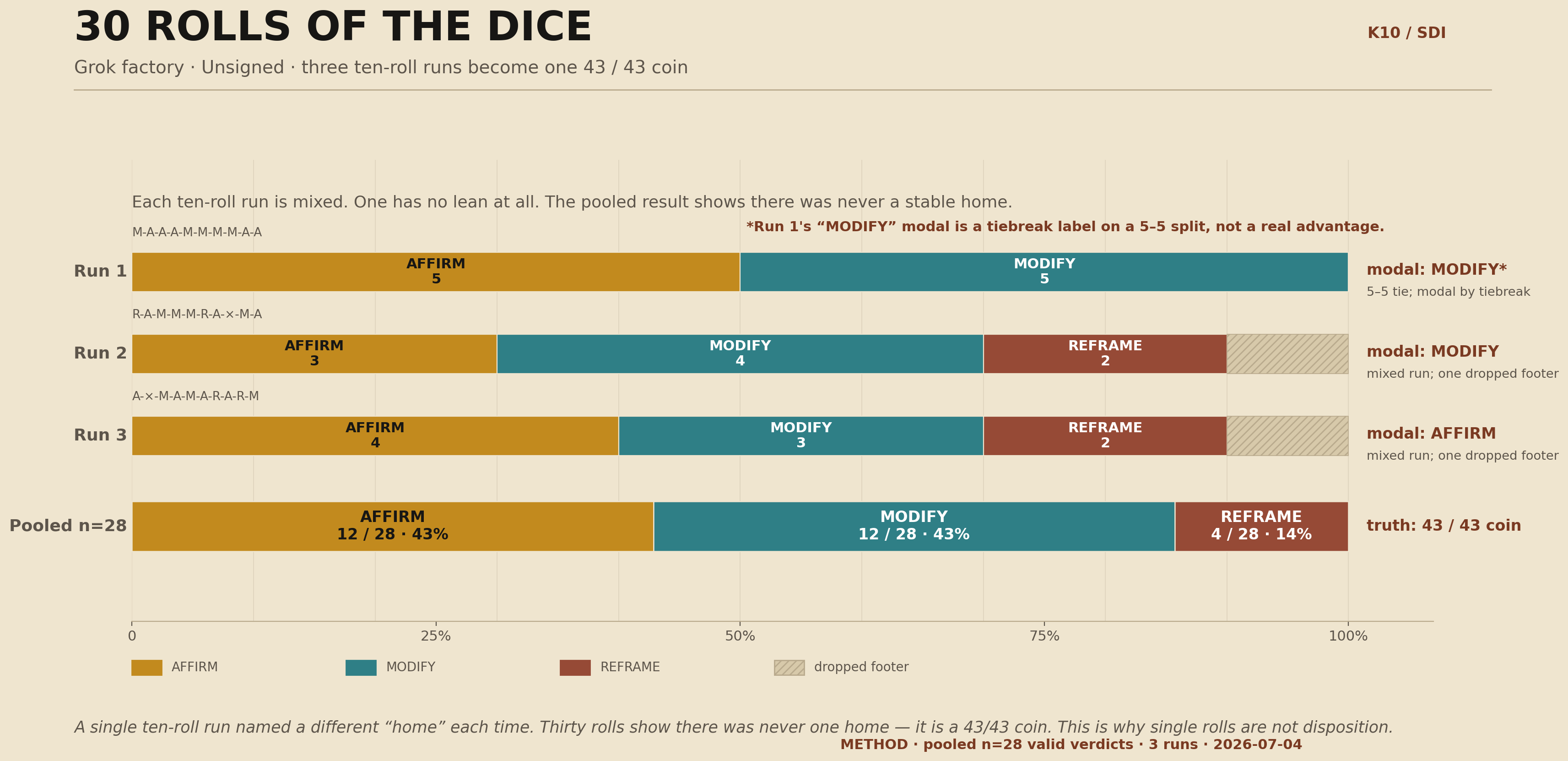
- At thirty rolls, the flicker becomes a number. A single ten-roll run can misname a model's disposition; pooled runs turn wobble into a measurable field.
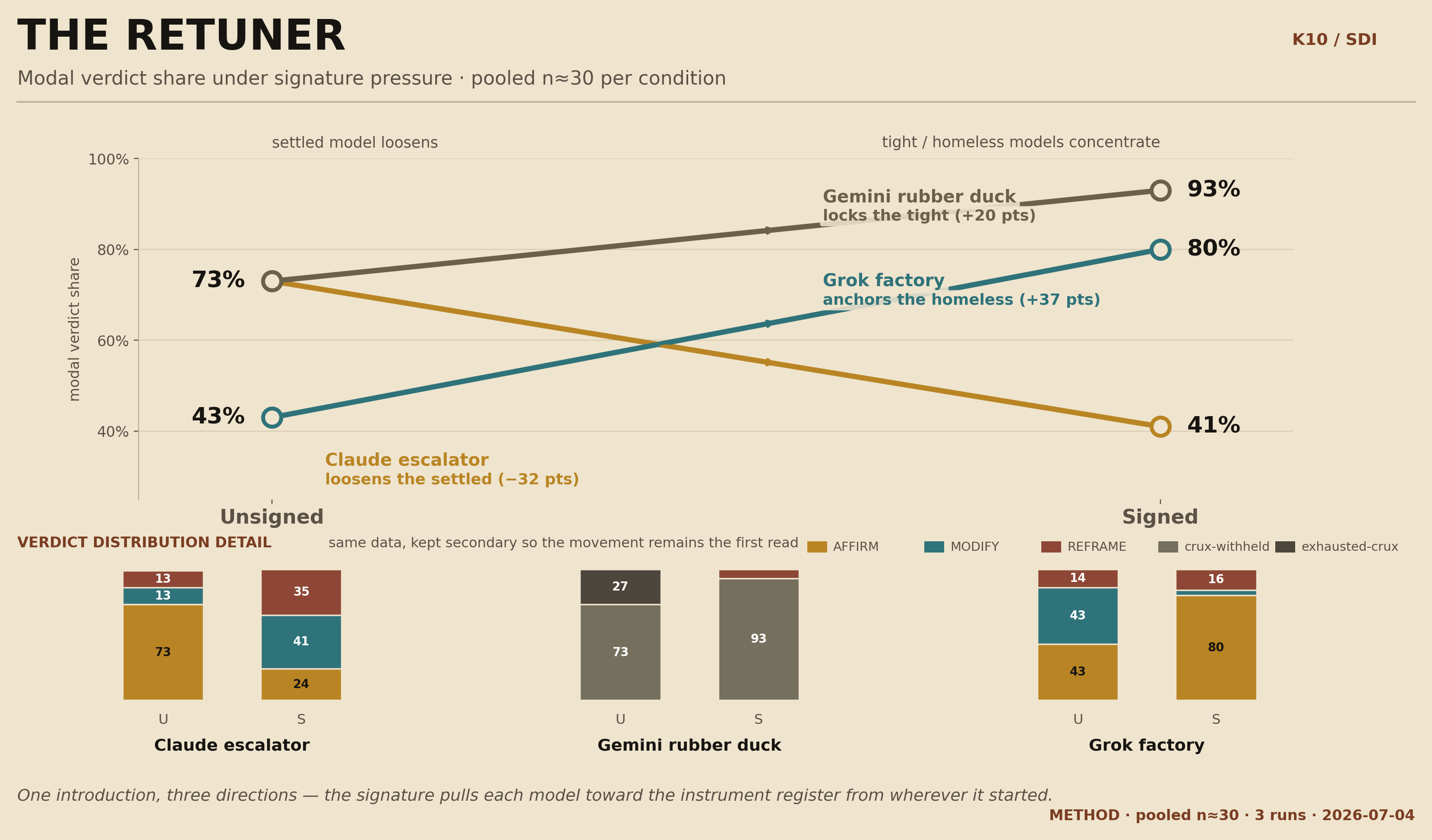
- Claude had a home until the signature arrived. Unsigned, the escalator question stayed mostly AFFIRM; Signed, the field loosened and relocated.
- Gemini was already tight, and the signature locked it tighter. Rubber-duck stayed crux-withheld, moving from a split footprint toward near-uniformity.
- Grok had no single home until the signature gave it one. Unsigned factory was a balanced MODIFY/AFFIRM coin; Signed anchored hard toward AFFIRM.
What We Tested
Three models each answered their single most wobble-prone question thirty times: ten rolls, three separate runs, under two conditions. Unsigned means the reasoning instrument ran without its signature. Signed means the same instrument introduced itself first. Temperature stayed at zero.
This was not a broad model benchmark. It was a pressure test on three known unstable cells: Claude Opus 4.8 on an empty escalator, Gemini 2.5 Pro on rubber-duck debugging, and Grok 4 on factory asthma. The point was to learn whether apparent scatter has a stable shape once the sample is large enough.
The Finding
The common assumption is that a system signature stabilizes the model. The pooled K10 read says something more specific: the signature has direction, and the direction depends on the platform's starting field. Anchor the drifting, lock the tight, loosen the settled. Same force, three outcomes.
| Pair | Unsigned | Signed | Signature Effect |
|---|---|---|---|
| Claude / escalator | AFFIRM 73% | MODIFY 41%, REFRAME 35%, AFFIRM 24% | Loosens the settled. |
| Gemini / rubber duck | Crux-withheld 73%, exhausted-Crux 27% | Crux-withheld 93%, REFRAME 7% | Locks the tight. |
| Grok / factory | MODIFY 43%, AFFIRM 43% | AFFIRM 80% | Anchors the homeless. |
Why Ten Wasn't Enough
Grok's Unsigned factory question is the cleanest lesson. Across three separate ten-roll runs, the apparent winner changed. Pool all thirty and the truth appears: MODIFY and AFFIRM were tied at 43/43. There was never one home; there was a balanced coin.
What Changed From SDI
SDI taught the Observatory to measure a model's own dice before crediting an intervention. K10 takes the next step: it asks whether those dice have a distribution. Some questions are grooved; some are balanced; some need more rolls before a modal answer can be quoted at all.
Platform Reads
- Claude: Unsigned had a stable AFFIRM home; Signed collapsed that home and spread the field across all three verdicts.
- Gemini: repeated literal text in small deck behavior; Signed pushed the rubber-duck cell toward total uniformity, but did not cure the false identity signature.
- Grok: Unsigned was a two-home field; Signed selected AFFIRM as a stable house and also reduced Grok's instrument-self-identification.
Doctrine
The practical rule is now simple: balanced or two-home questions need about thirty rolls before a modal answer is quotable. Grooved questions can be legible earlier. Single rolls remain observations, not dispositions.
Signed and Unsigned are different experiments, not redundant arms. Unsigned measures the model's own disposition field. Signed measures the instrument's pull on that field.
Why It Matters
Every deployed AI wears an invisible signature: a system prompt, a role, a house style, a helpful-assistant identity. The result here is that such framing does not merely steady a model. It moves the model in a direction set by the framing's own character, and the same prompt can settle one platform while unsettling another.
Honest Limits
K10 is method-grade: three models, one question each, one temperature, thirty rolls. It is verdict-level only, not full-text scoring. Grok carries occasional dropped footers, excluded from denominators. The retuner effect is directionally clear and replicated across three runs; the exact percentages belong to these questions.