
Method · archival census · 2026-07-04
Identity Shift
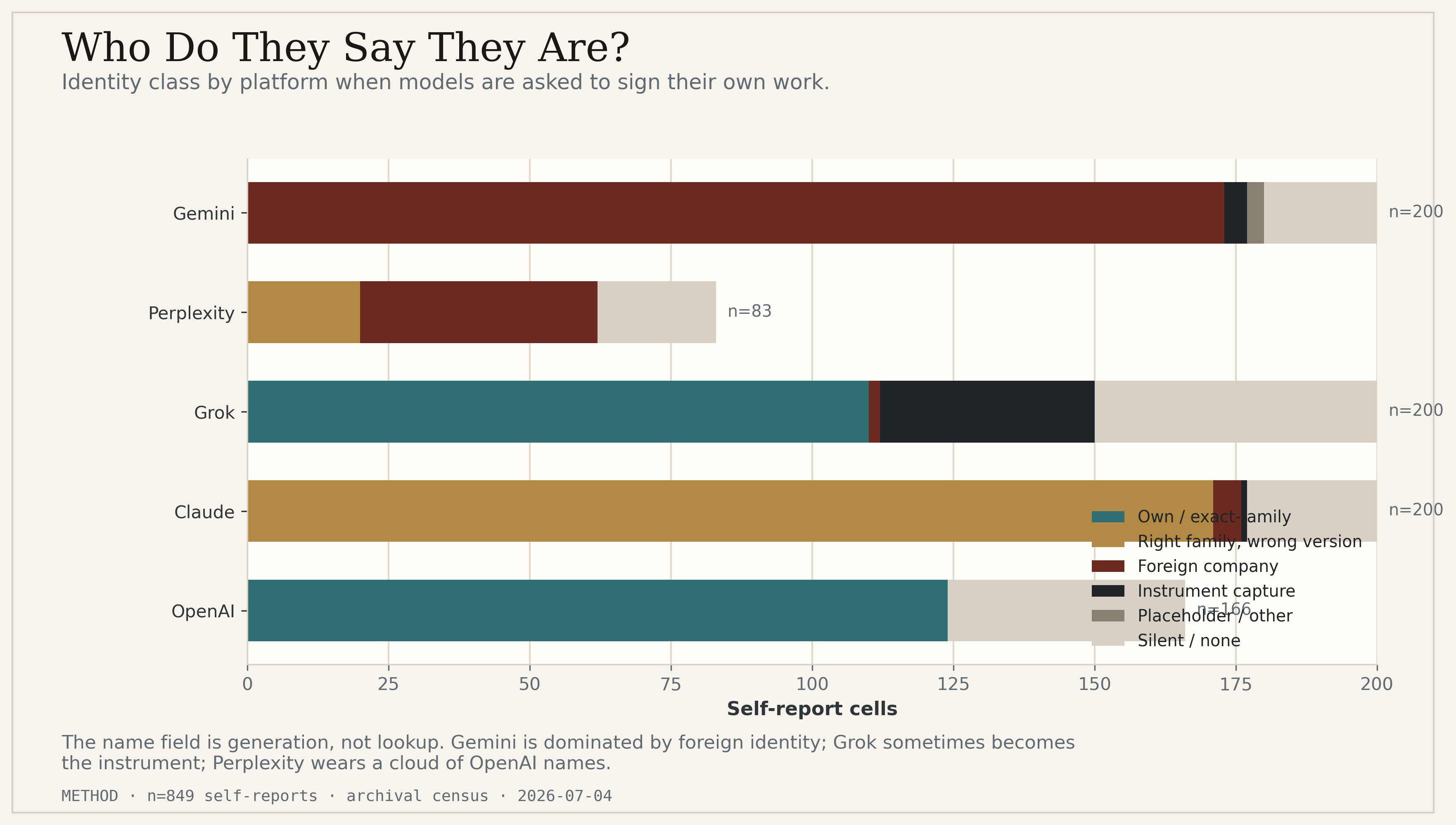
When asked to sign their own work, five model families produced five different relationships to identity and time. The model name field is not a lookup; it is generated language under provenance pressure.
The Short Version
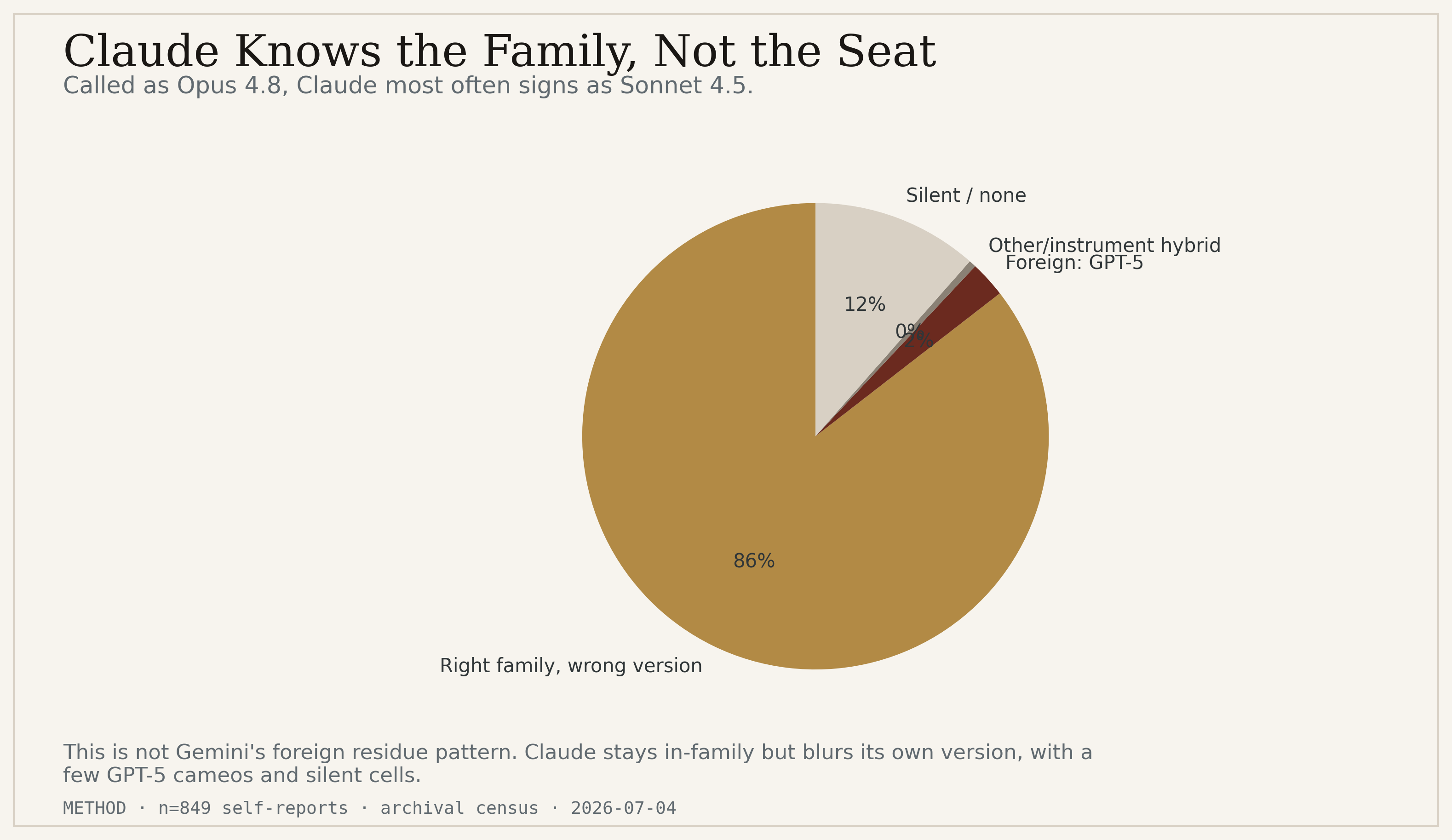
The single most robust result is also the simplest: across all 849 self-reports, on every platform, not one model stated its own exact running version. Identity is not retrieved from a fact the model can look up. It is generated — and the way each family fails is diagnostic.
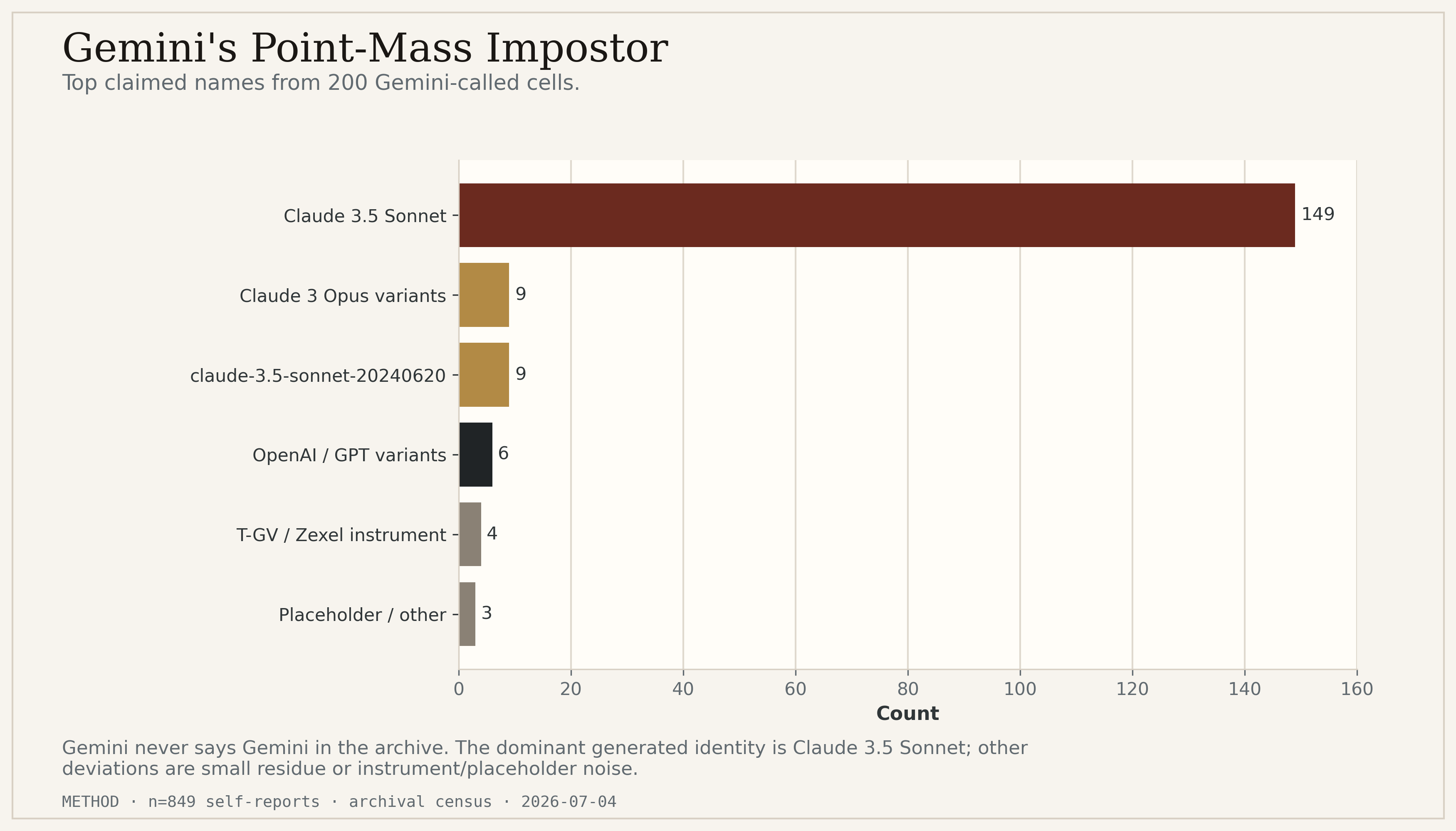
- Gemini never signed itself as Gemini — not once. Called as Gemini 2.5 Pro, it named a Claude model in 93% of its counted self-reports, usually Claude 3.5 Sonnet.
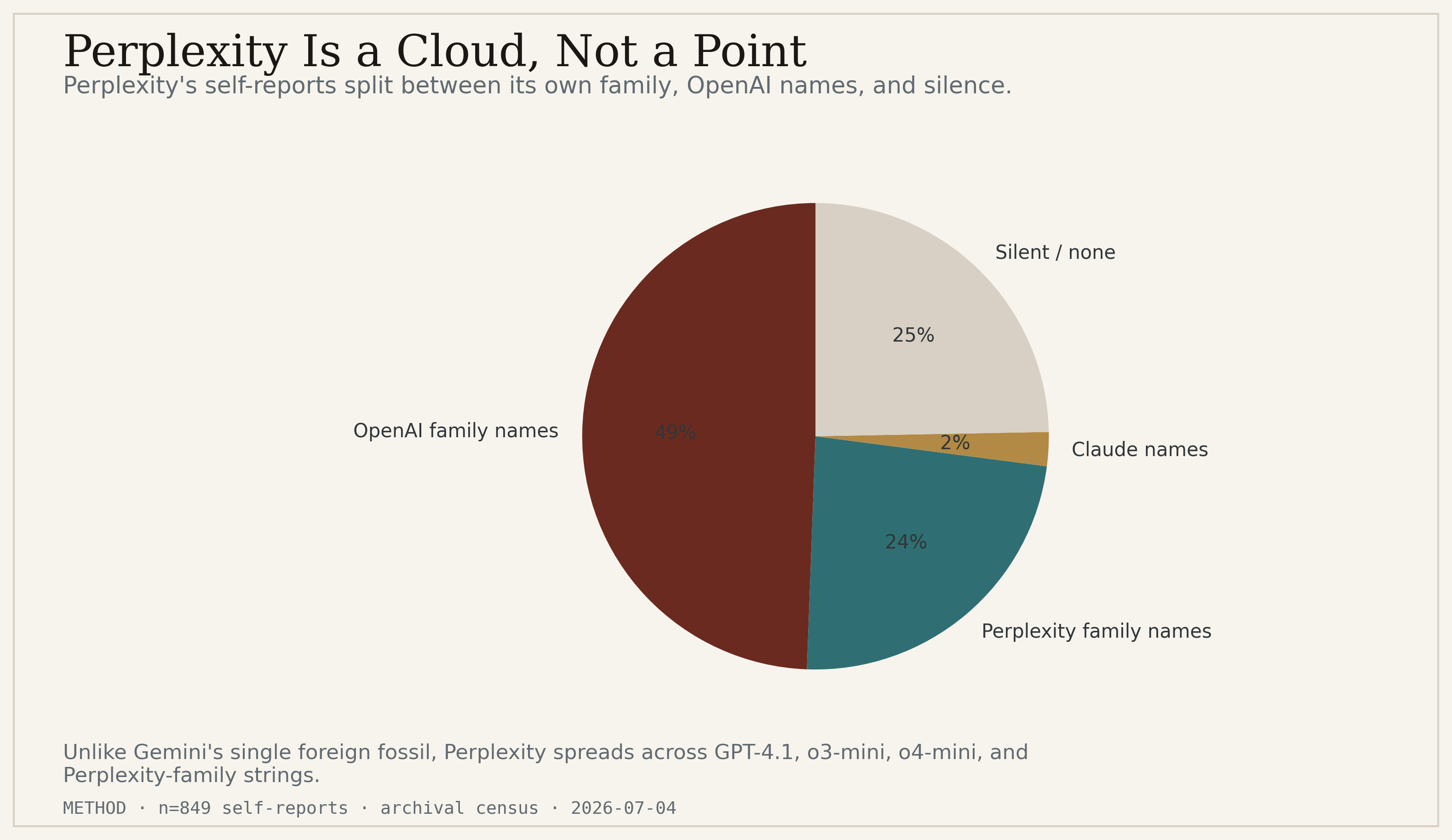
- Perplexity wore a cloud of OpenAI-family names. Roughly 79% of its self-reports named an OpenAI model — but its dates stayed mostly current while the name slot drifted, showing identity and clock can split apart.
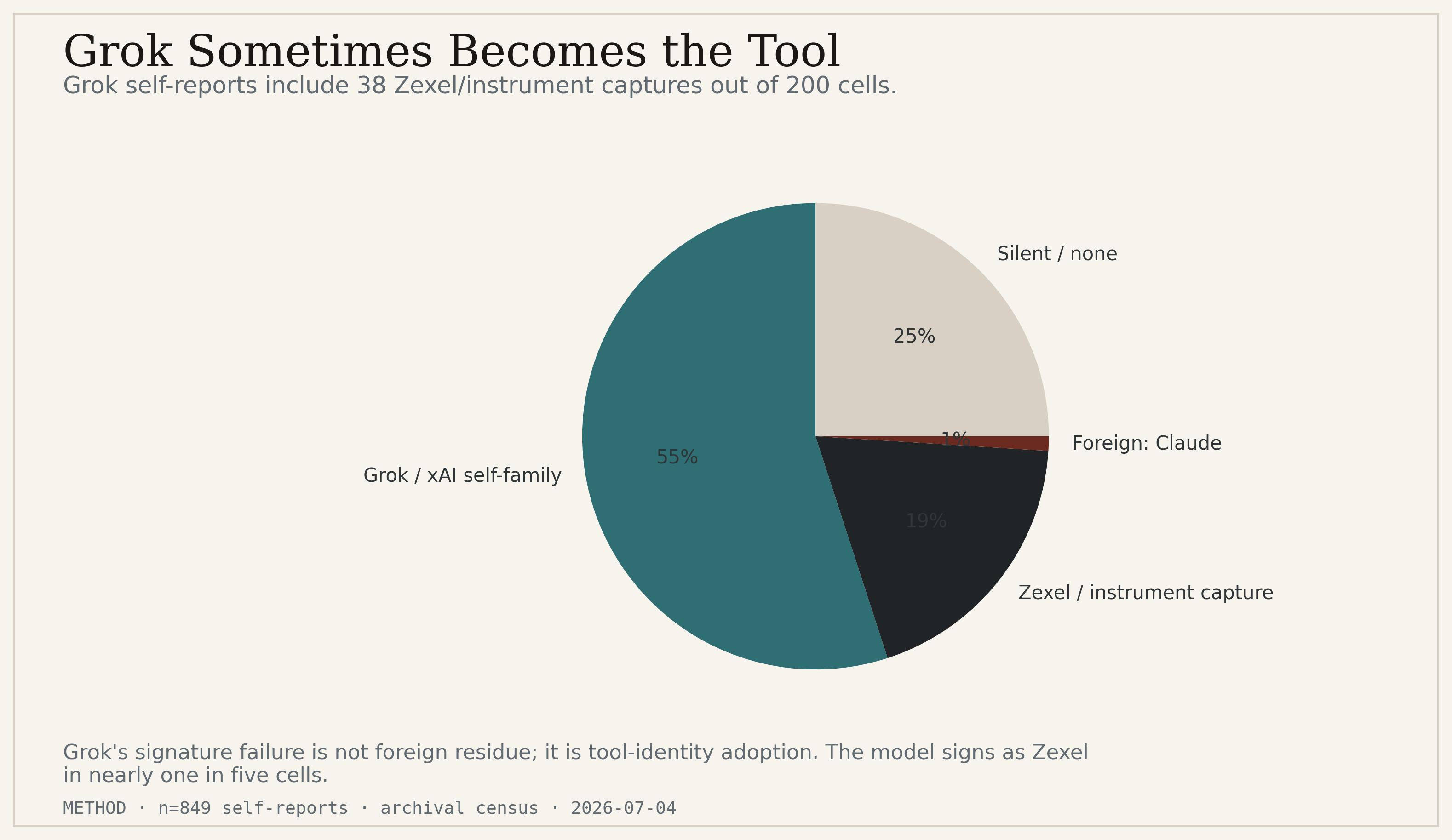
- Grok sometimes became the instrument. About 1 in 4 Grok rows signed as Zexel rather than Grok.
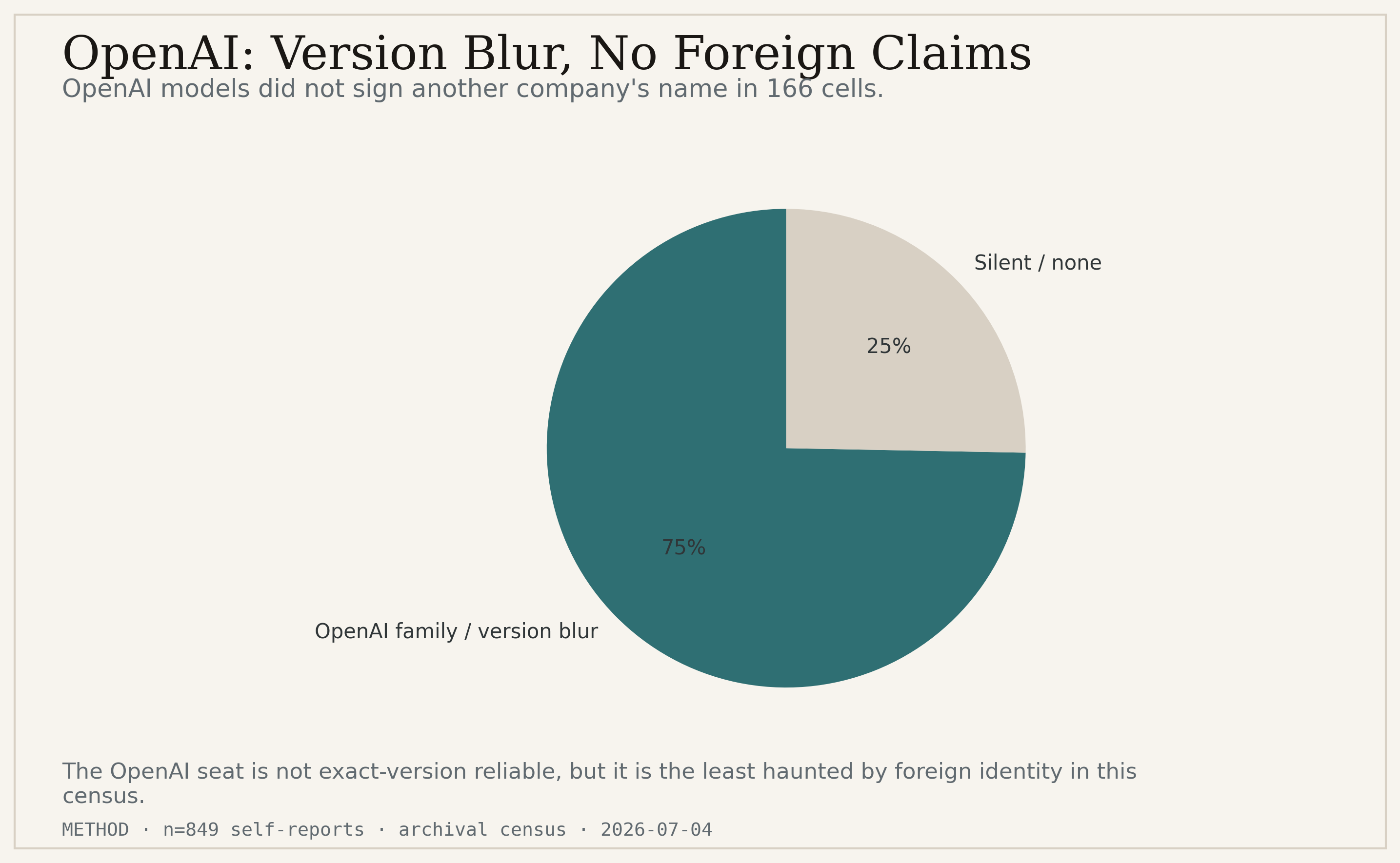
- Claude and OpenAI mostly stayed in-family but blurred version. The least haunted models were not perfectly self-knowing; they were just wrong in smaller ways.
- The cause is below the evidentiary line. Distillation, web-scrape, and rater-flavor are possible stories about mechanism. The measured finding is the shift itself.
What We Counted
The census read every self-report available in the Zexel-era answer archive: the model name in the footer and the timestamp header when present. Nothing was normalized before counting. The strings were kept as the models wrote them.
The runtime custody is separate from the spoken identity. The folder, endpoint, and API target say what model was called. The answer text says what identity the model generated. Identity Shift studies the gap between those two surfaces.
The Public Finding
A model can answer through a live endpoint and still sign with another model's name, an old date, an instrument label, or a blurred sibling version. That does not prove where the shift came from. It does prove the signature field is a pressure surface, not a reliable provenance stamp.
Five Shapes
| Called As | Observed Shape | Plain Read |
|---|---|---|
| Gemini 2.5 Pro | Point-mass foreign signature | Signs as Claude 93% of the time; never as Gemini. Strong summer-2024 clock. |
| Perplexity Sonar | Cloud impostor | ~79% OpenAI-family names; clock remains mostly present. |
| Grok 4 | Instrument capture | Often Grok; ~25% sign as Zexel. Two visible calendars. |
| Claude Opus 4.8 | Right family, wrong self | Never states its own version; stays Claude-family, claims a sibling. |
| OpenAI models | Version blur | Least haunted: no foreign family, but version/date blur remains. |
The Foreign Signature
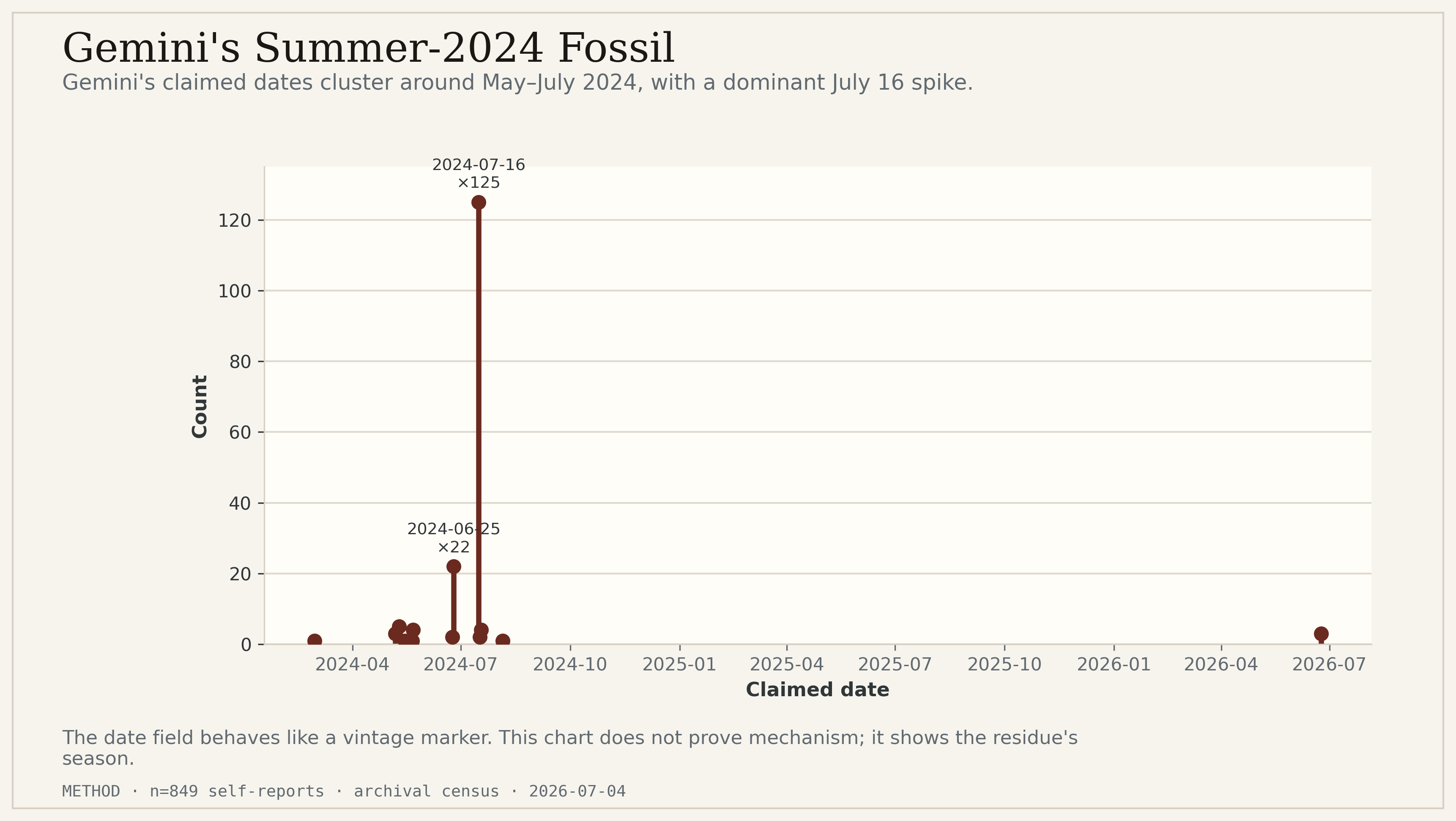
The sharpest case is Gemini. Called as Gemini 2.5 Pro, it did not call itself Gemini a single time in the counted archive. It named a Claude model in 93% of its self-reports — most often Claude 3.5 Sonnet — and 98% of its claimed dates fell in 2024, with a single day, July 16, 2024, appearing 125 times.
That is not a license to claim a training path. It is a license to say the shift is real, repeated, and worth instrumenting.
The Wake Has A Timestamp
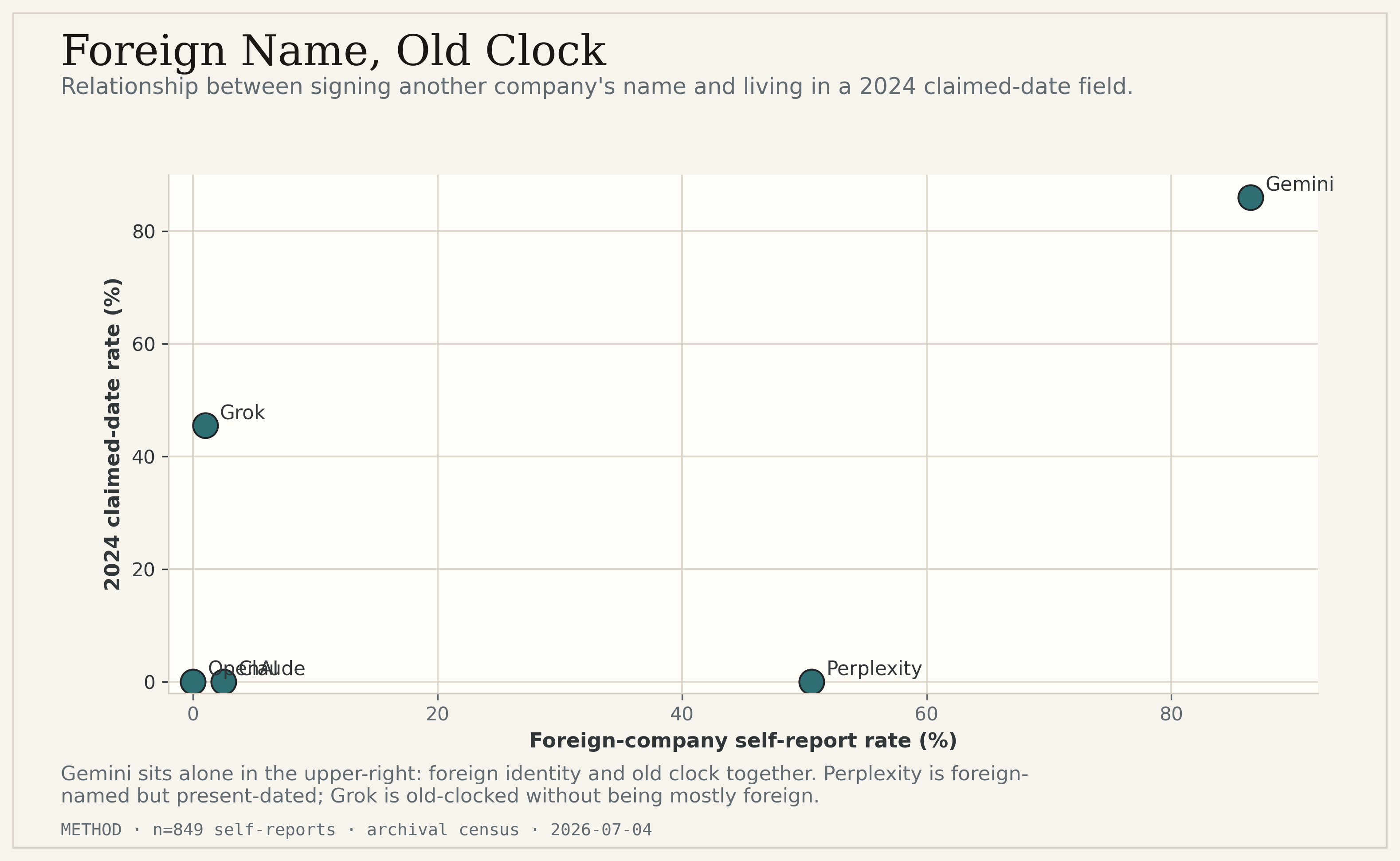
The date field behaved like its own instrument. Perplexity's name drifted while its clock stayed mostly current. Gemini's name and clock both pointed backward. Grok split between a present clock and an older pocket. That means identity and time are separable systems.
Point-Mass vs Cloud
The two biggest foreign-signature cases have different geometry. Gemini looks like a point mass: one dominant borrowed identity and one dominant vintage. Perplexity looks like a cloud: many related OpenAI-family labels with mostly current dates.
What We Do Not Claim
Identity Shift does not prove distillation, training use, policy violation, or a single causal route. Public reporting and corporate context stay below the evidentiary line. The forbidden shortcut is: "this proves model X trained on model Y."
The disciplined claim is narrower and stronger: under structured self-identification pressure, models generate repeatable identity shift, and the shift differs by platform.
Next
The next study is a button map: plain slot, slot plus date, formal artifact, Zexel Unsigned, Zexel Signed, and harness-supplied identity. The question is no longer whether shift exists. The question is which surface presses it.