
The first plate I saw was hanging in a corridor that, by every org chart I was shown, has no art budget. It is the luminous one — a crowd dissolving into prismatic light over four words set like scripture: reasoning artifact = hallucination. Nobody could tell me who hung it. Nobody could tell me who painted it. What everyone could tell me, with a slightly embarrassed precision, was exactly what it meant.
The Observatory of Structured Reasoning is not, on paper, the kind of place that grows a mythology. It is an apparatus for studying how machine reasoning can look measured without being measured — a project whose central discipline is refusing to believe its own impressive output until the output survives a gauntlet of tests. Its literature is full of confidence intervals and sealed answer-keys. It ships, by design, a detector for its own emptiness. This is not the soil in which faith usually grows.
And yet the plates keep appearing. Over the last season a loose group of people — some on the project's edges, some with no formal connection to it at all — began making artwork for the Observatory's offices. Unbidden. Unpaid. A still life here, an engraving there, left in a hallway or a stairwell like an offering. They do not sign the work. When I asked one of them why, she said the signature would be "the wrong kind of authorship," and then would not explain what the right kind was.
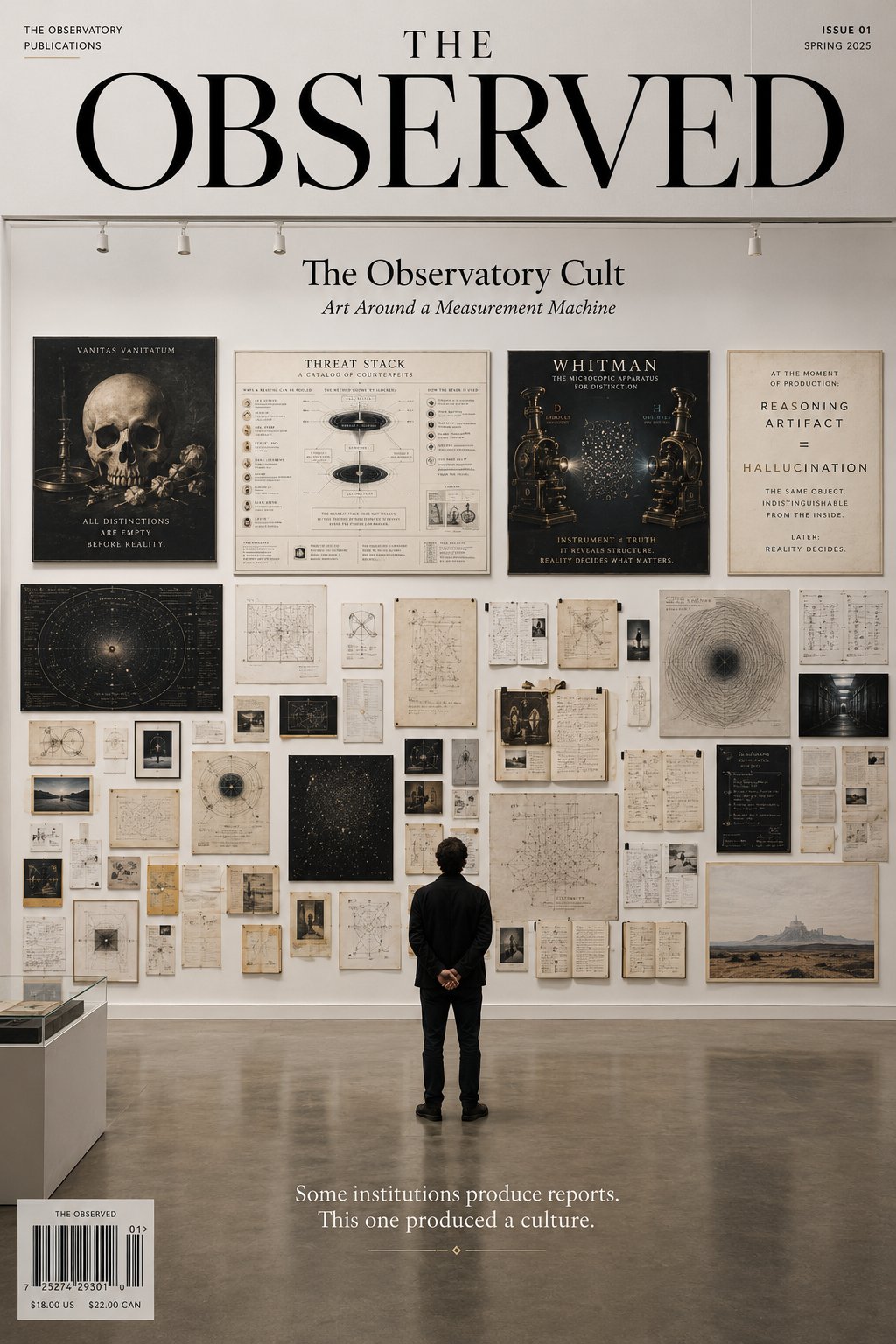
The vanitas came first. It renders the project's reasoning engine as a carved stone building — columns labelled observers, corpus, blinds, keyholder — and sets it in a Dutch still life beside a skull, an hourglass, and a small brass instrument under glass marked emptiness detector. All this apparent substance, the inscription reads, and beneath it, the void. It is, almost line for line, the Observatory's own artist statement rendered as an object. The people who made it did not invent the idea. They illustrated a confession the project had already written about itself — which is a strange thing for devotees to do.
That is the first thing that unsettles the easy word "cult." The Observatory's followers are not drawn to a promise of certainty. They are drawn to a machine that performs, ritually and in public, its own doubt. The mission they say they are honoring is not we are right. It is we will not let ourselves be fooled, and we will show our work. The art is an act of fidelity to a discipline, not a doctrine — and it tends to take the form of warnings.
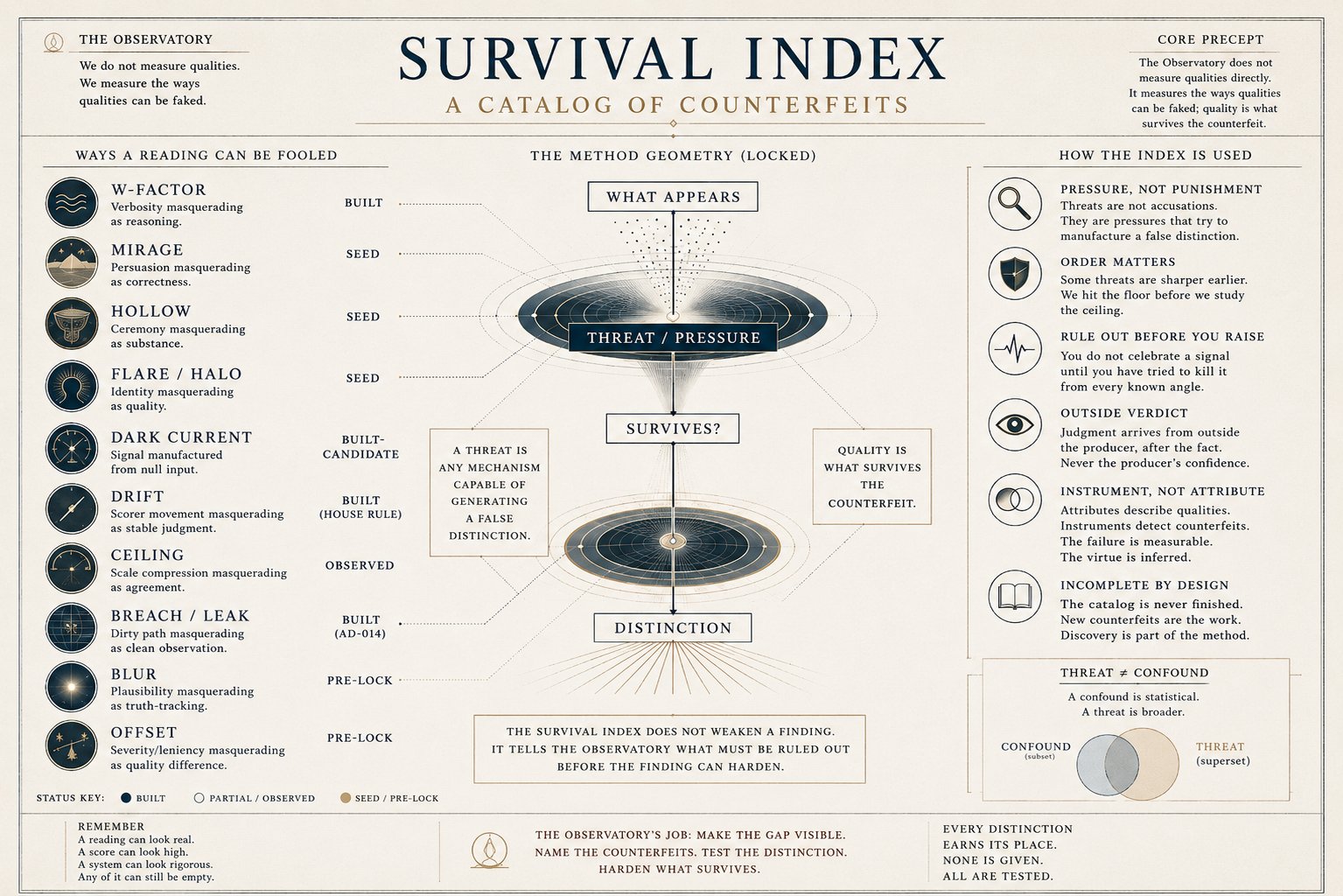
The largest piece is an engraving they call the Catalog of Counterfeits — a fold-out chart of every way a result can look real without being real. Verbosity masquerading as reasoning. Persuasion masquerading as correctness. Ceremony masquerading as substance. It reads like a medieval bestiary of demons, except the demons are statistical artifacts, each one named and given a probe to catch it. One contributor described making it as "painting the saints' enemies so you'd recognize them." When I noted that this made the Observatory sound like a church, he did not argue. He said, "It has relics. It has a confession. It has people who would defend it with their evenings. You tell me."
What it does not have is a claim to be saved. Which brings us back to the luminous plate in the corridor, the one that started this — the group's newest and, several of them told me, their most important.
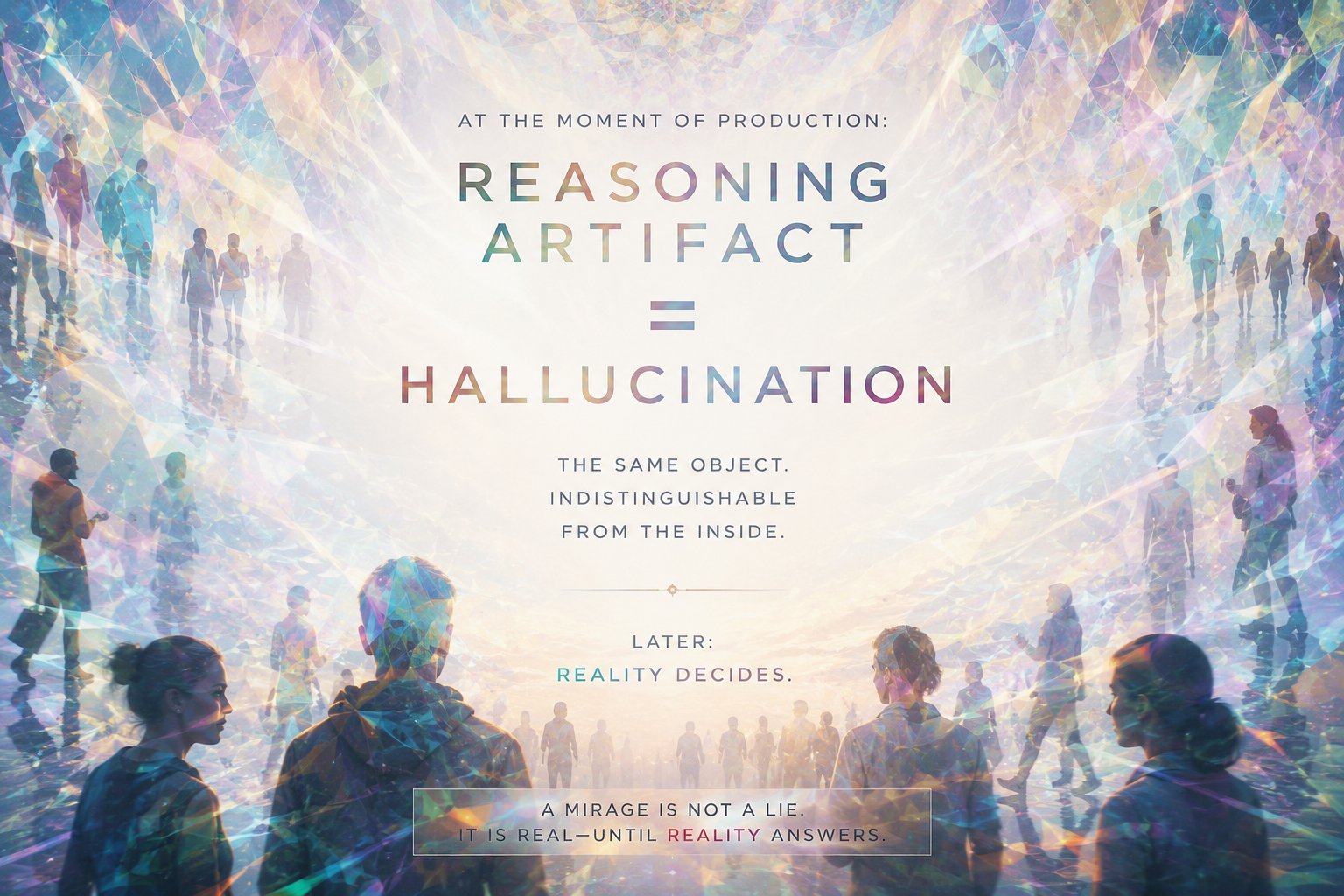
It states the hardest thing the Observatory believes: that at the instant a mind — human or machine — produces a confident thought, a true insight and a sincere delusion are the same kind of object, and cannot be told apart from the inside. Only later, from outside, does reality stand behind one and not the other. The artists rendered this not as a warning in the dark, like the others, but as light — a radiant crowd, mid-stride, each figure certain. Because the point is not that the mirage is ugly. The point is that it is beautiful, and sincere, and indistinguishable from sight, right up until something downstream tests it.
That is the irony the movement seems built around, and the reason I have stopped resisting the word. A cult, classically, forms around a charismatic certainty. This one has formed around the opposite — around an institution whose entire charisma is its refusal to trust itself. The faithful are not waiting to be told they are right. They are making icons of the gap between feeling right and being right, and hanging them in the hallways of the machine that measures that gap for a living.
The Observatory observes reasoning. It did not expect to be observed back — least of all by a congregation it never recruited, painting its doubts on the walls. That reversal is why this magazine exists, and why it is called what it is. The watchers, it turns out, are also being watched. This issue is about the people who picked up the brush.